
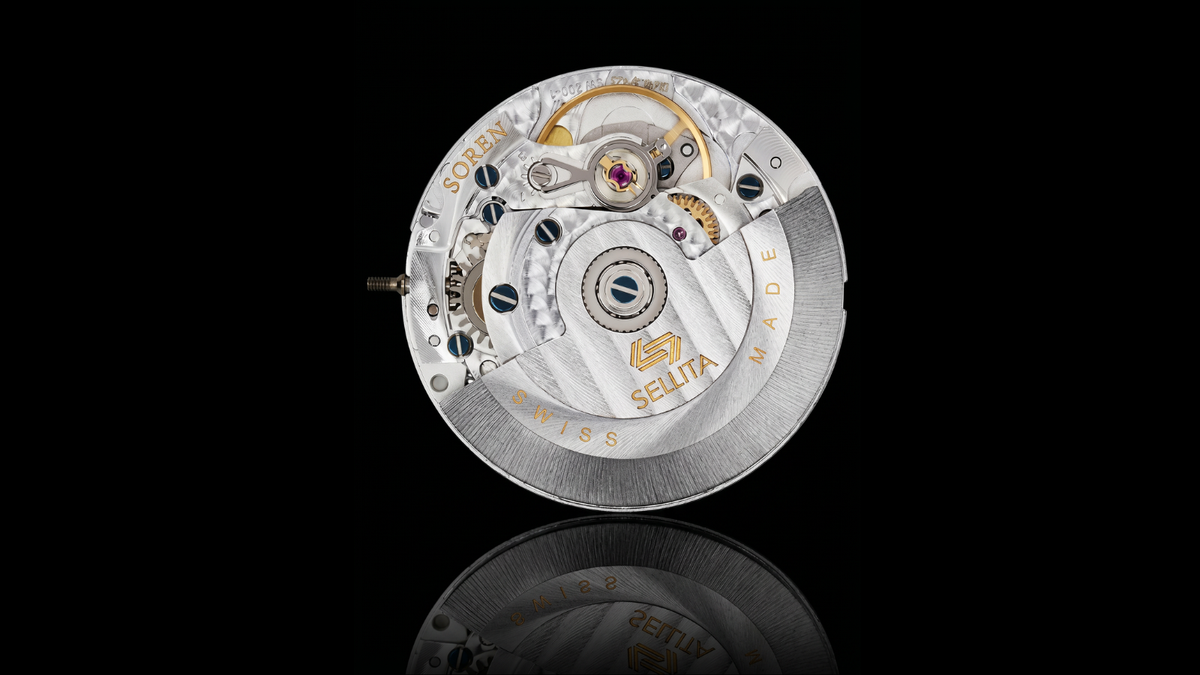
Every Soren watch runs on a Sellita SW200. It is a decision we made deliberately — and one we want to explain fully. This guide covers everything a watch buyer needs to know about the SW200: where it came from, how it works, how it compares to the alternatives, and what owning one actually means over time.
If you are considering a Swiss Made watch in the €600–1,500 range, this is the movement you will encounter most often. Understanding it makes you a more informed buyer — regardless of which brand you ultimately choose.
What Is Sellita Watch Co.?
Sellita Watch Co. SA was founded in La Chaux-de-Fonds, Switzerland — the same city that has been the geographic and cultural centre of Swiss watchmaking since the 18th century. The Jura mountains around La Chaux-de-Fonds once provided the long winters that drove local artisans indoors and into the precision trades. Today the city is a UNESCO World Heritage Site, recognised specifically for its watchmaking heritage.
For most of the 20th century, ETA SA — a subsidiary of the Swatch Group — was the dominant supplier of movements to Swiss watch brands. Brands from Tudor to Breitling to TAG Heuer built their reputations on ETA-powered watches, and the 2824-2 became one of the most widely deployed watch movements in history.
In 2002, ETA announced it would phase out movement deliveries to third-party brands — a move designed to consolidate Swatch Group's vertical integration but one that threatened to leave hundreds of independent Swiss watchmakers without a reliable movement supply. The Swiss Competition Commission eventually intervened to manage the phase-out, but the message was clear: the industry needed an alternative.
Sellita stepped into that gap. The company invested significantly in engineering a direct replacement for the ETA 2824-2, developing the tooling, manufacturing processes, and quality controls to produce a drop-in compatible movement at scale. The SW200 was the result — and it has since become the movement of choice for independent Swiss watch brands that want Swiss Made certification without dependence on the Swatch Group.
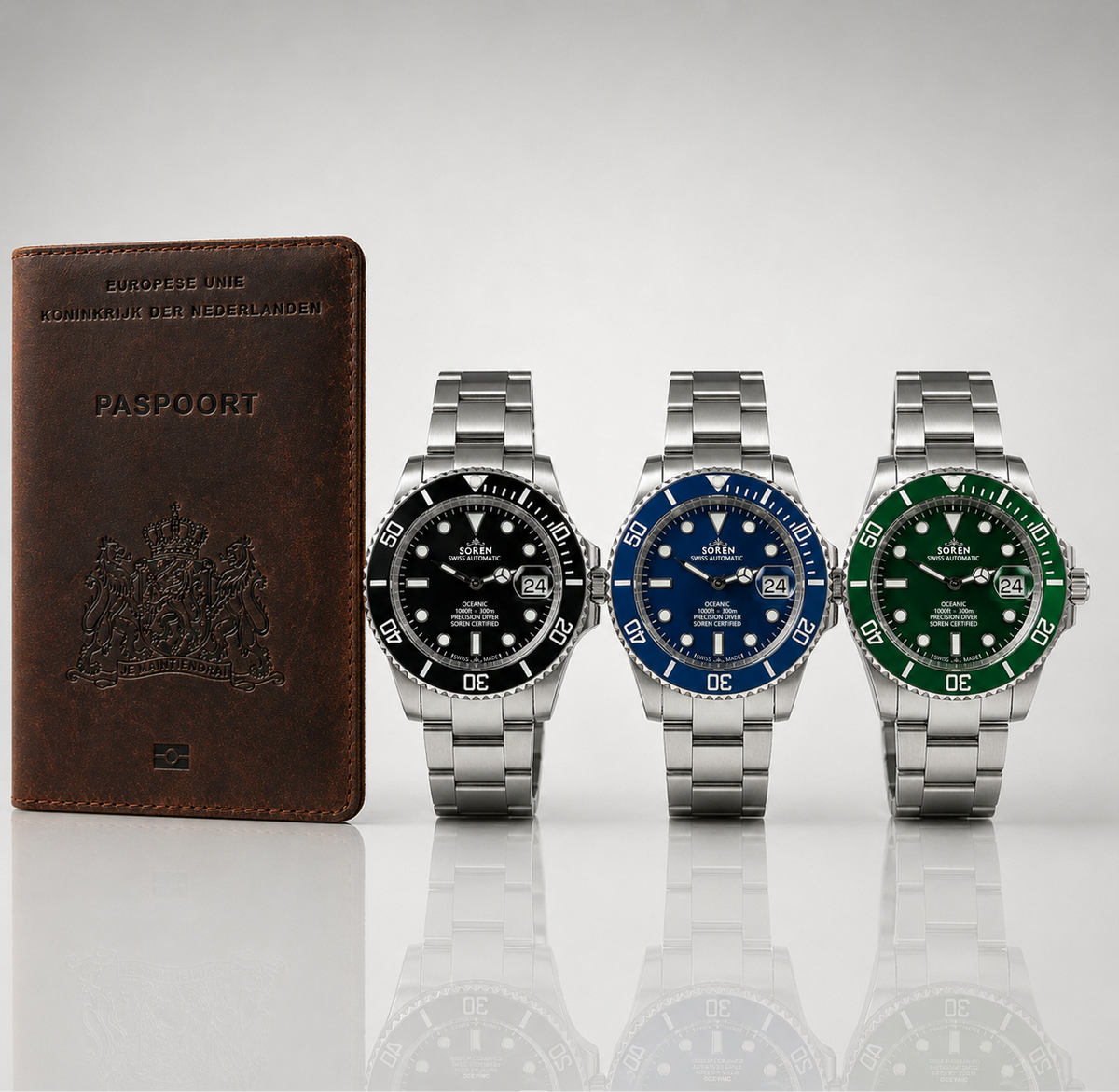
Today, Sellita supplies movements to brands from €400 dress watches to €4,000 sport pieces. The SW200 is the one that powers the Soren Oceanic and Soren Momentis.
SW200 Technical Specifications
The SW200 is available in two primary configurations:
| Specification | SW200-1 | SW200-2 Power+ |
|---|---|---|
| Diameter | 25.6mm | 25.6mm |
| Height | 4.6mm | 4.6mm |
| Frequency | 28,800 vph (4 Hz) | 28,800 vph (4 Hz) |
| Power reserve | 38 hours | 65 hours |
| Jewels | 26 | 26 |
| Accuracy (standard) | -4/+6 sec/day | -4/+6 sec/day |
| COSC Chronometer | Available (-2/+2 sec/day) | Available |
| Swiss Made | Yes — assembled in La Chaux-de-Fonds | Yes |
Both the Soren Momentis and the Oceanic run the SW200-1.
The Sellita SW200-2 Power+: What's New in 2026 In early 2026, Sellita introduced the SW200-2 Power+ — an evolution of the SW200 that maintains the same smooth 28,800 vibrations per hour while extending the power reserve to 65 hours. Our full SW200-2 Power+ guide covers the upgrade in detail.
What changed: Power reserve: from 38-42 hours (SW200) to 65 hours - Beat rate: unchanged at 28,800 bph (the same fluid sweep) - Architecture: redesigned barrel and mainspring - Jewels: 26 (unchanged)
What stayed the same:
28,800 bph — the smooth, continuous sweep that separates quality automatics from cheaper alternatives - Swiss Made certification - Compatibility with existing SW200 cases
The difference from Powermatic 80:
Swatch Group's Powermatic 80 achieves 80 hours by reducing the beat rate to 21,600 bph — which results in a slightly jumpier second hand. The SW200-2 Power+ keeps the high beat rate while adding power reserve. That's the better engineering choice.
Soren's position:
Soren's Oceanic and Momentis currently run the proven SW200-1. As Sellita phases in the SW200-2, Soren will evaluate the upgrade — but the current movement is already the industry benchmark.
The SW200 operates at 28,800 vibrations per hour — a beat rate that balances accuracy with energy efficiency. At this frequency, the seconds hand sweeps smoothly rather than ticking in discrete steps. This sweep is one of the visual signatures of a quality automatic movement, and one of the details that distinguishes Swiss Made automatics from lower-cost alternatives.
The 26-jewel count refers to synthetic ruby bearings placed at high-wear contact points inside the movement. These reduce friction and wear, extending the movement's service life. More jewels is not automatically better — the number reflects engineering decisions about where friction reduction is needed most.
How an Automatic Movement Works
The SW200 is a self-winding mechanical movement. It requires no battery and no electrical charge. It is powered entirely by the kinetic energy generated by the natural motion of your wrist during daily wear.
Inside the movement, a semicircular rotor — a weighted half-disc — pivots freely around the movement's central axis. When your wrist moves, the rotor swings with inertia, and that motion winds a mainspring through a series of gears. The mainspring stores mechanical energy and releases it in a controlled, regulated flow that drives the hands.
When fully wound, the SW200 stores approximately 38 hours of power reserve. This means a watch left unworn overnight will continue running through the following day. If the watch is left unworn for more than 38 hours, it will stop and need to be manually wound — roughly 20 to 30 turns of the crown — before it will run again.
This is not a flaw. It is the fundamental nature of mechanical watchmaking — a tradition unbroken since the 18th century. The SW200 requires no external power source, produces no electronic waste, and can be serviced and run indefinitely by any trained watchmaker.
Sellita SW200 vs ETA 2824-2: The Real Differences
The SW200 and the ETA 2824-2 are functionally interchangeable. Both share the same case dimensions, the same jewel count, and near-identical architecture. A watchmaker trained on one can service the other without retraining, and parts are largely compatible.
The differences are at the finishing and regulation level:
Regulator design: The ETA 2824-2 uses an Etachron regulator — a device for fine-tuning the movement's rate. The SW200 uses a proprietary Sellita regulator. Both are effective. The Etachron is more widely known to independent watchmakers because of its longer market history, but this is increasingly irrelevant as SW200 experience accumulates across the industry.
Availability: The SW200 is currently more accessible to independent brands than the ETA 2824-2, which Swatch Group continues to supply selectively. This is precisely why Soren — and hundreds of other independent brands — use Sellita rather than ETA.
Price to the end consumer: There is no meaningful difference. The SW200 does not cost more or less than an equivalent ETA movement at the consumer level. The difference is a manufacturing detail, not a quality gap.
For the person wearing the watch, the distinction between SW200 and ETA 2824-2 is negligible. Both are Swiss Made. Both run at 28,800 vph. Both have a 38-hour power reserve in standard configuration. Both will last decades with proper servicing.
Sellita SW200 vs Miyota 9015 vs Seiko NH35
| Feature | Sellita SW200 | Miyota 9015 | Seiko NH35 |
|---|---|---|---|
| Frequency | 28,800 vph | 28,800 vph | 21,600 vph |
| Power reserve | 38 hours | 42 hours | 41 hours |
| Accuracy | -4/+6 sec/day | -10/+30 sec/day | -20/+40 sec/day |
| Jewels | 26 | 24 | 21 |
| Service interval | 5–7 years | 3–5 years | 3–5 years |
| Service cost (Europe) | €150–250 | €80–150 | €50–100 |
| Swiss Made | Yes | No | No |
Miyota 9015: The Miyota 9015 is an excellent movement. Citizen's manufacturing precision is genuine, and the 9015 has a strong track record in the €300–800 watch segment. The SW200 wins on accuracy specification — -4/+6 vs -10/+30 seconds per day — and on service interval, meaning fewer visits to a watchmaker over a decade of ownership. The 9015 is a Japanese movement; it does not qualify for Swiss Made certification.
Seiko NH35: The NH35 is Seiko's budget automatic calibre, used in watches from €100 to €300. It is robust and proven, but its accuracy tolerance — -20/+40 seconds per day — reflects its price point. The NH35 runs at 21,600 vph rather than 28,800, which results in a tick-tick-tick seconds hand motion rather than a smooth sweep.
The SW200 is not the cheapest automatic movement available. It is the right movement for a watch intended to be worn every day, serviced every five to seven years, and owned for decades.
Real-World Accuracy: What to Expect From Your Soren
The specification of -4/+6 seconds per day means the SW200 will gain or lose a maximum of six seconds in any 24-hour period under standard conditions. In practice, this translates to less than three minutes of drift per month — or approximately 30 seconds per week.
Several factors affect accuracy in daily use:
Position: A movement lying flat runs differently than one vertical. Most manufacturers calibrate movements across six positions — dial up, dial down, crown left, crown right, crown up, crown down — to average out positional differences. Soren watches are regulated in Switzerland before dispatch.
Temperature: Extreme cold slows lubricants; extreme heat thins them. Normal indoor temperatures between 15°C and 25°C have no measurable effect on accuracy.
Magnetic fields: Strong magnets can affect accuracy temporarily by influencing the balance spring. The SW200 is not anti-magnetic by specification, but the field strength required to cause an issue is well beyond everyday exposure. Loudspeakers, smartphone speakers, and standard bag closures do not generate sufficient field strength to affect a watch's accuracy.
Running-in period: A new movement may run slightly outside specification for the first four to eight weeks as lubricants settle and components wear to their optimal contact points. If your Soren runs slightly fast or slow in the first month, give it time before drawing conclusions.
If you want to measure your Soren's accuracy precisely, apps like Oscillowatch (available on iOS and Android) use the device microphone to count the movement's beat frequency and calculate the daily rate. It is an easy and satisfying way to understand how your watch is performing.
Service Intervals and the True Cost of Ownership
Sellita recommends service every five to seven years under normal conditions. A service involves:
- Complete disassembly of the movement
- Ultrasonic cleaning of every component
- Inspection and replacement of any worn parts
- Re-lubrication with watchmaker-grade oils and greases
- Reassembly and regulation to specification
Average service cost in Europe for an SW200: €150–250, depending on the watchmaker and any parts required. In the Netherlands, established watchmakers in Amsterdam, Rotterdam, and Eindhoven can service SW200-based movements.
Over a 20-year ownership period — assuming two services — the total additional cost is €300–500. No smartphone, no laptop, and no other personal device offers a comparable ownership trajectory. A well-serviced automatic movement can run for 40 years or more. The movement inside a Soren watch today could still be running in 2065.
This is one of the reasons we chose the SW200 over less expensive alternatives. The movement is repairable, serviceable, and supported by a European network of trained watchmakers. Choosing a cheaper movement would have reduced our cost per watch — but it would have reduced the watch's longevity and your ability to service it locally.
How to Recognise the SW200 in a Watch
From the outside, you cannot see the movement while wearing the watch — unless the case has a display back. Several Soren models use solid stainless steel case backs, which is a finishing choice rather than a movement consideration.
On watches with display backs, the SW200 is identifiable by:
- The Sellita logo and "SW200" engraving on the rotor
- The signature red-tipped Sellita rotor on some configurations
- The 25.6mm movement diameter visible through the sapphire display back
If you are buying a pre-owned watch and want to verify the movement, a watchmaker can confirm the calibre during a quick inspection without removing the case back.
Why Soren Uses the SW200
We had options. There are Chinese-manufactured automatic calibres available for a fraction of the SW200's cost, some of which are cosmetically similar. There are Japanese options like the Miyota 9015 that are reliable and well-regarded. We chose the SW200 for four reasons:
Swiss Made certification. The SW200 is assembled and inspected in La Chaux-de-Fonds. Soren's Swiss Made designation — a legally verified standard, not a marketing claim — is only possible because of this. Every Soren watch carries the Swiss Made label because every Soren movement earns it.
European service network. Any certified watchmaker in the Netherlands, Germany, Belgium, or France can service an SW200. Parts are available through established supply chains. Training is widespread. You will not need to send your watch overseas for maintenance.
Accuracy specification. -4/+6 seconds per day is achievable because the movement is well-manufactured and properly regulated. A Soren watch, out of the box, should run within this tolerance.
Longevity. The SW200 has a track record in demanding conditions across thousands of watch models. We want Soren watches to last for decades. That requires a movement with a proven record — not a component we are using as an experiment.
We had the option to save approximately €50 per watch by using a Miyota 9015. We chose the SW200 instead. The decision adds to our cost. We believe it adds more to your watch.
Watches That Use the Sellita SW200
The SW200 is trusted by brands at multiple price points:
- Soren Oceanic — €695–725 — SW200-1, Swiss Made dive watch, 30 ATM
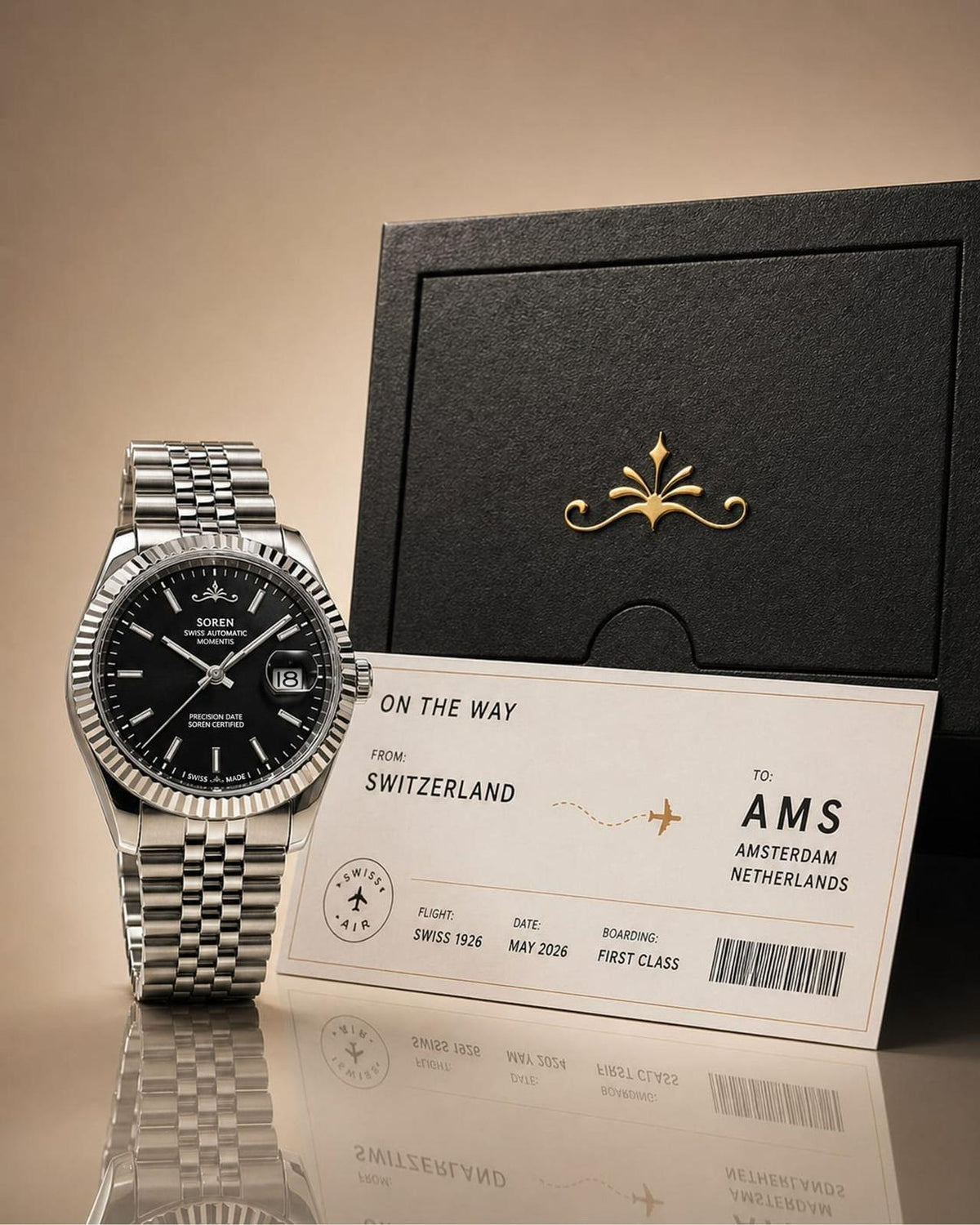
- Soren Momentis — €625–655 — SW200-1, everyday automatic, 10 ATM
- Frederique Constant Classics — €800–1,200
- Norqain Adventure Sport — €1,500+
- Christopher Ward C60 — €800–1,200
- Mido Ocean Star — €700–1,000
- Tissot — selected models, alongside ETA supply
The fact that the same movement platform powers watches from €625 to €4,000+ is not a coincidence. It is a testament to how reliable and respected the Sellita SW200 has become in the decade since its introduction.
Frequently Asked Questions
Does the SW200 need to be wound manually? Only if left unworn for more than 38 hours. During regular daily wear, the rotor keeps the mainspring wound automatically. If the watch stops, wind it 20 to 30 times via the crown before setting the time.
Is the SW200 waterproof? The movement itself is not inherently water-resistant — water resistance is a property of the case, not the movement. The Soren Oceanic offers 30 ATM water resistance; the Soren Momentis offers 10 ATM. Both are achieved through case construction, gaskets, and a screw-down crown — not through any modification to the SW200.
Can I have my Soren serviced locally? Yes. Any certified watchmaker who works with Swiss movements can service an SW200. The parts are widely available and the calibre is well-documented. You do not need to return the watch to Soren for routine maintenance, though our warranty covers manufacturing defects for two years from purchase.
What if the watch runs fast or slow? A small deviation — within -4/+6 seconds per day — is within normal specification. If your watch is consistently running outside this range after the first two months of wear, contact us at support@sorenwatches.com. Under the 2-year warranty, regulation adjustments are covered.
How does the SW200 compare to an in-house movement? In-house movements — calibres designed and manufactured entirely within one brand — exist primarily at price points above €2,000. At €625–695, the SW200 is the appropriate choice. It is Swiss Made, accurate, and serviceable. The premium for an in-house movement at this price point would require compromising on case materials, water resistance, or bracelet quality — trade-offs we were not willing to make.
The Bottom Line
The Sellita SW200 is a Swiss Made automatic movement with a proven track record, a European service network, and an accuracy specification that matches or exceeds movements costing significantly more. It is the movement inside every Soren watch because it is the right movement for a watch built to be worn every day, maintained over decades, and passed on eventually.
If you are buying your first Swiss Made automatic watch, the SW200 is an excellent place to start — and an honest one.
For a broader look at what to expect from Swiss Made watches at this price point, read our Complete Guide to Swiss Made Watches Under €700.
Discover the Soren Momentis — Sellita SW200-1, Swiss Made automatic from €625 Shop the Momentis
Discover the Soren Oceanic — Sellita SW200-1, Swiss Made dive watch from €695 Shop the Oceanic


Leave a comment
This site is protected by hCaptcha and the hCaptcha Privacy Policy and Terms of Service apply.