I was seventeen when I started looking for my first proper watch.
Not a fashion watch. Not something with a battery that would feel cheap within a year. I wanted a real Swiss Made automatic. Something I'd be proud to wear every day, and keep for decades.
I had a budget. Not unlimited, but enough. And still, I couldn't find it.
Everything affordable felt cheap. And everything that felt right cost a multiple of what it was actually worth. I remember standing in a mall in Spain, looking at a watch behind glass, thinking the same thing so many people think and never say out loud: this price doesn't match what this is.
I didn't know it yet, but I'd just run into the biggest open secret in the watch industry.
The part nobody tells you
Here's what I learned once I started digging.
Most Swiss automatic watches, across a huge range of prices, run on the same handful of movements. The engine inside the watch, the part that actually makes it tick, often comes from the same two or three Swiss manufacturers.
One of them is Sellita. Their SW200-1 is one of the most respected automatic movements in the world. It's built to the standards of traditional Swiss watchmaking, and it's identical in construction to the ETA 2824-2, the benchmark the entire industry has trusted for decades.
That exact movement sits inside watches from respected names like Oris. It sits inside watches from Christopher Ward. Excellent brands, both of them. And it sits inside the SOREN Momentis.
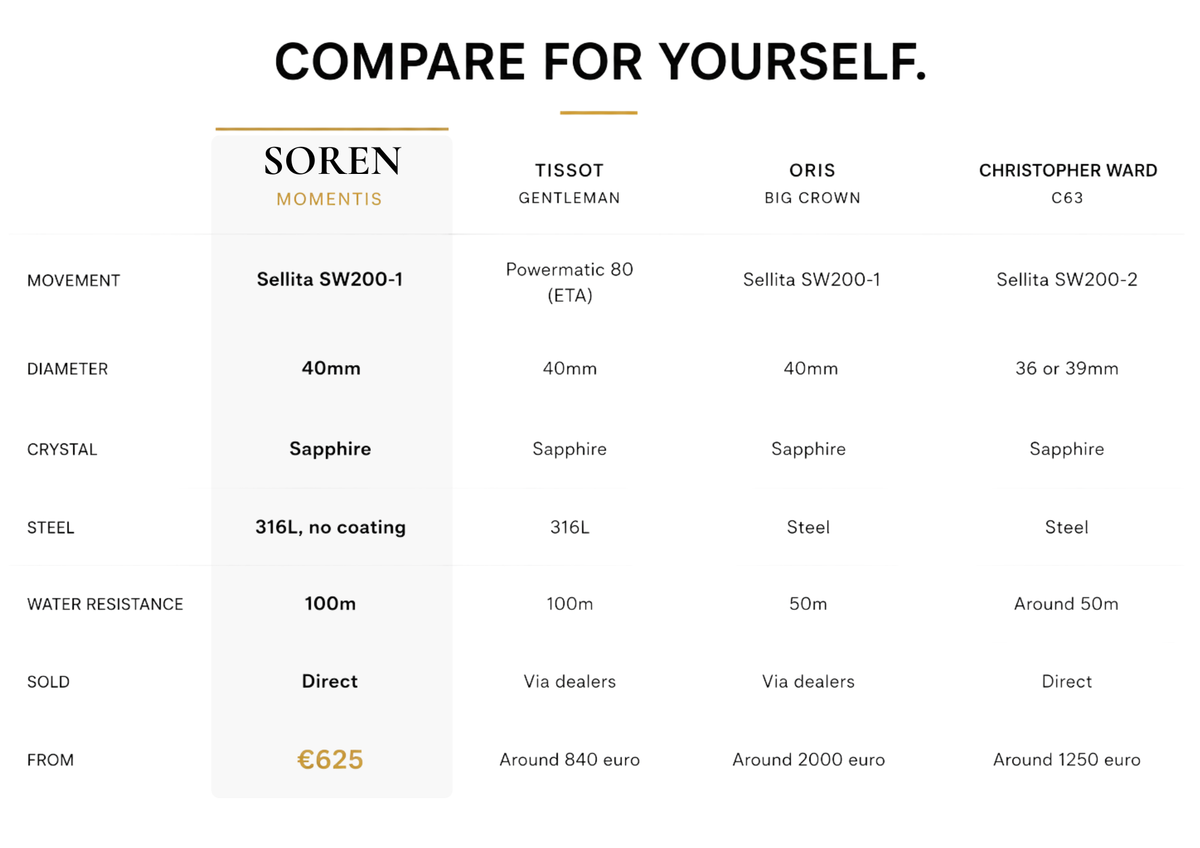
The movement is the same. The sapphire crystal, the steel, the finishing, all comparable. So I kept asking the question the industry hopes you won't:
If the engine is the same, why is one watch 600 euro and another 2,500?
Where your money actually goes
The answer isn't quality. The answer is everything wrapped around the watch.
When you buy from a traditional brand, you're not just paying for the watch. You're paying for the boutique on the expensive street. The distributor. The retailer's margin. The advertising campaigns with famous faces. Layer on layer of cost, added on top of the watch, long before it ever reaches your wrist.
The watch might cost a few hundred euro to make. By the time it's passed through every hand that wants a cut, the price on the glass has doubled, tripled, or worse.
That's not me being cynical. That's just how the traditional model works. And once you see it, you can't unsee it.
So I built the watch I couldn't find
I decided to do the obvious thing that almost nobody does. Take the same Swiss movement, the same quality of steel and sapphire, build a watch to the same standard, and sell it directly to the person who wears it.
No boutique. No distributor. No middlemen taking a cut. No markup for a name you're paying to advertise.
That's SOREN. And that's the Momentis.

Not a claim on a page. A number you can hold.
Compare it yourself
I don't ask you to take my word for it. The whole point of SOREN is that you can check.
Same movement family. The same standard of finishing. Direct from the maker, without the retail markup. The difference in price isn't the watch. It's everything the traditional model piles on top of it.

Swiss Made automatic, from 625 euro. The same movement, without the retail markup.
30-day return, free EU shipping, 2-year warranty
What you're really deciding
If you want the name on the dial, and the boutique experience that comes with it, those brands are worth it, and I mean that honestly. They're excellent watches.
But if what you actually want is a proper Swiss Made automatic, built to last, at a price that matches what it is, then you were never really paying for the watch. You were paying for everything around it.
I built SOREN so you don't have to.

Swiss Made automatic, from 625 euro. The same movement, without the retail markup.
30-day return, free EU shipping, 2-year warranty
WhatsApp opens with your message ready to send