
At the €400–800 price point, Swiss Made and Japanese automatic watches sit side by side in every comparison guide, forum thread, and Reddit post about first serious watches. A Seiko Presage costs €350. A Soren Momentis costs €625. The question of which offers better value is entirely legitimate — and answering it honestly is more useful than defending either tradition reflexively.
This guide covers movements, finishing, accuracy, servicing costs, and total cost of ownership. There is no objectively "better" choice — but there are clear scenarios where one outperforms the other. By the end of this comparison, you will know which applies to you.
The Swiss Watchmaking Tradition — What You Are Actually Buying
Swiss watchmaking is concentrated in three regions: the Vallée de Joux, the Jura arc, and La Chaux-de-Fonds. These areas developed a specialised watchmaking workforce over three centuries, building institutional knowledge that still represents the standard against which other national traditions are measured.
The Swiss Made designation is not a marketing claim. It is legally defined under Swiss Federal Council Ordinance SR 232.119, which requires that at least 60% of production costs occur in Switzerland and that the movement is assembled and inspected there. A brand that misuses the label faces criminal prosecution under Swiss law.
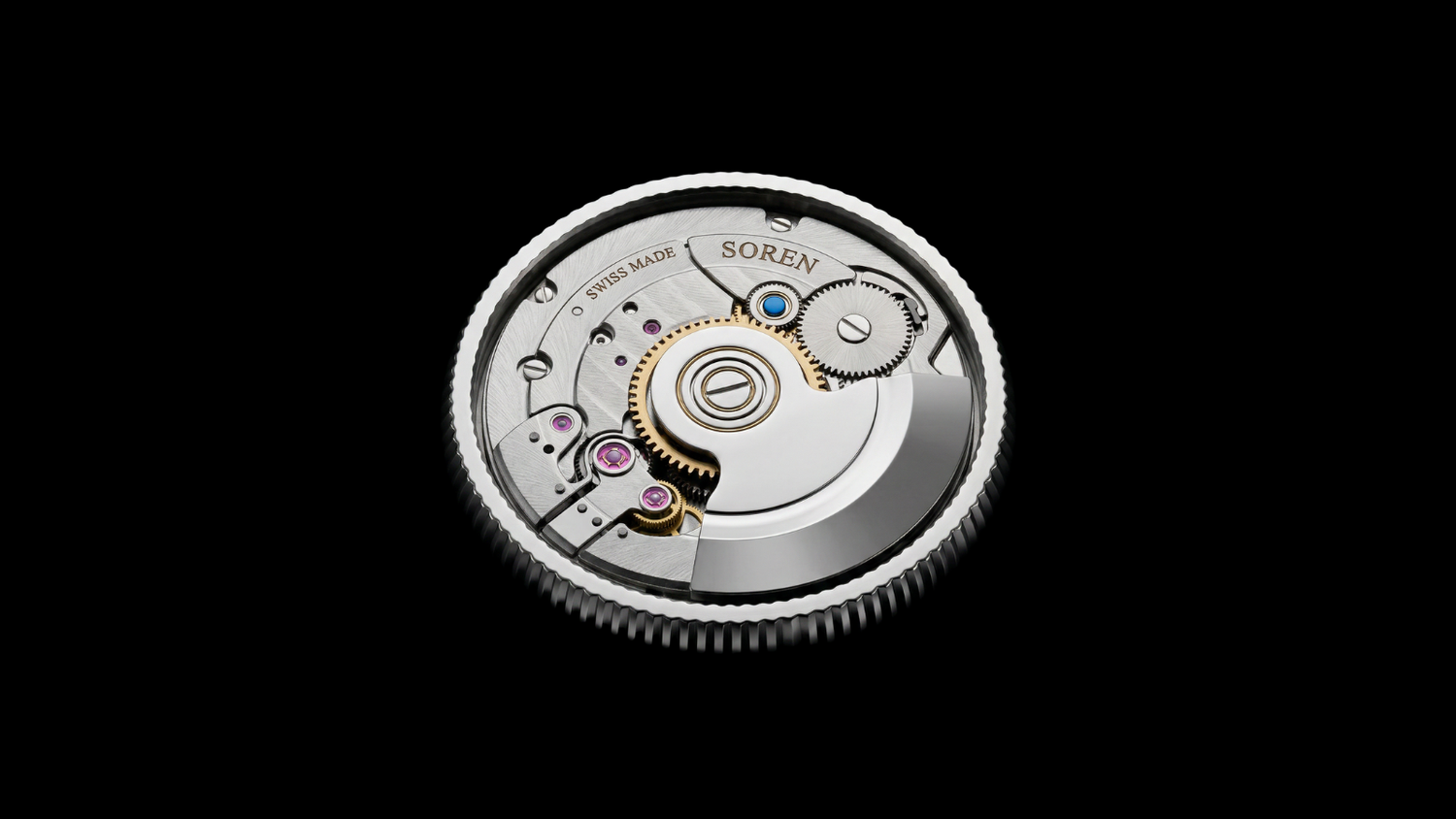
Sellita Watch Co., the manufacturer of the SW200 movement used in every Soren Oceanic and Soren Momentis, is based in La Chaux-de-Fonds and has been producing movements since 2002. The SW200 is assembled, regulated, and inspected in Switzerland — which is why every Soren watch carries the Swiss Made label on the dial.
For a full breakdown of what Swiss Made actually means in legal and practical terms, read our Complete Guide to Swiss Made Watches Under €700.
Swiss finishing traditions — Côtes de Genève striping, perlage on movement plates, blued screws — are time-consuming decorative techniques that increase manufacturing cost significantly. On an SW200 at the €600 price point, finishing is functional rather than decorative. The movement is clean, well-machined, and regulated to specification — it is not hand-finished in the manner of a €5,000 piece. That distinction matters at higher price points. At sub-€1,000, it is largely irrelevant to daily wear experience.
Japanese Automatic Watches — The Case for Seiko and Miyota
Japan's watchmaking tradition is built around Seiko, founded in 1881, and Citizen, whose Miyota division produces the movements found in hundreds of watch brands worldwide. Both have developed genuine in-house manufacturing capabilities that rival Swiss brands in scope.
Seiko in particular produces its own mainsprings, escapement components, crystals, and hands — a level of vertical integration that most Swiss manufacturers cannot match. This is a genuine point of respect for the Japanese tradition and worth acknowledging in any honest comparison.
Miyota 9015
The Miyota 9015 is the Japanese movement most directly comparable to the Sellita SW200. Produced by Citizen's Miyota division in Ina, Japan, it is used in watches from €400 to €1,200 and has earned a strong reputation for reliability and consistency. It operates at 28,800 vph, offers 42 hours of power reserve, and runs accurate to -10/+30 seconds per day.
Brands using the Miyota 9015 include Christopher Ward (some models), Halios, and numerous microbrands in the €400–800 range. It is a well-regarded movement — not a compromise choice.
Seiko NH35
The NH35 is a different proposition: a budget automatic calibre used in watches from €100 to €300, including the Seiko 5 range and many entry-level microbrands. It is robust, widely serviced globally, and has an enormous track record.
The NH35 operates at 21,600 vph rather than 28,800 — which produces a visible stepping seconds hand rather than a smooth sweep. Its accuracy tolerance of -20/+40 seconds per day reflects its price point. For a watch bought at €150, the NH35 is excellent. At €400 and above, the Miyota 9015 and Sellita SW200 are the appropriate calibres.
Seiko Presage and Orient Star
At the €300–600 range, Seiko's Presage line and Orient Star represent Japanese watchmaking at its most competitive. Both offer in-house movements — the Seiko 4R35 and Orient's calibre F6922 respectively — with finishing quality that punches above their price point. These are genuine competitors to Swiss options at equivalent prices.
Movement Comparison: SW200 vs Miyota 9015 vs NH35
| Feature | Sellita SW200 | Miyota 9015 | Seiko NH35 |
|---|---|---|---|
| Frequency | 28,800 vph | 28,800 vph | 21,600 vph |
| Power reserve | 38–42 hours | 42 hours | 41 hours |
| Accuracy | -4/+6 sec/day | -10/+30 sec/day | -20/+40 sec/day |
| Jewels | 26 | 24 | 21 |
| Service interval | 5–7 years | 3–5 years | 3–5 years |
| Service cost (Europe) | €150–250 | €80–150 | €50–100 |
| Swiss Made | Yes | No | No |
| Seconds hand | Smooth sweep | Smooth sweep | Stepping |
The SW200 leads on accuracy specification and service interval. The Miyota 9015 leads on power reserve — 42 hours versus 38 in the standard SW200 configuration. The NH35 is competitive on upfront service cost but requires more frequent servicing, which narrows that advantage significantly over time.
For a complete technical breakdown of the Sellita SW200 — including its history, specifications, and how it compares in real-world wear — read our Sellita SW200 Movement Guide.
Finishing and Build Quality: Where the Differences Are Visible
At the sub-€800 price point, finishing differences between Swiss and Japanese watches are real but subtle. The most meaningful differences are at the dial and case level rather than the movement level — because neither tradition hand-finishes movements at this price point.
What Swiss brands typically offer at €600–800:
- Applied indices — three-dimensional markers separately attached to the dial, rather than printed
- Sapphire crystal with anti-reflective coating as standard
- Brushed and polished case finishing following traditional proportions
- Solid end links on bracelets — not hollow, which rattles and wears faster
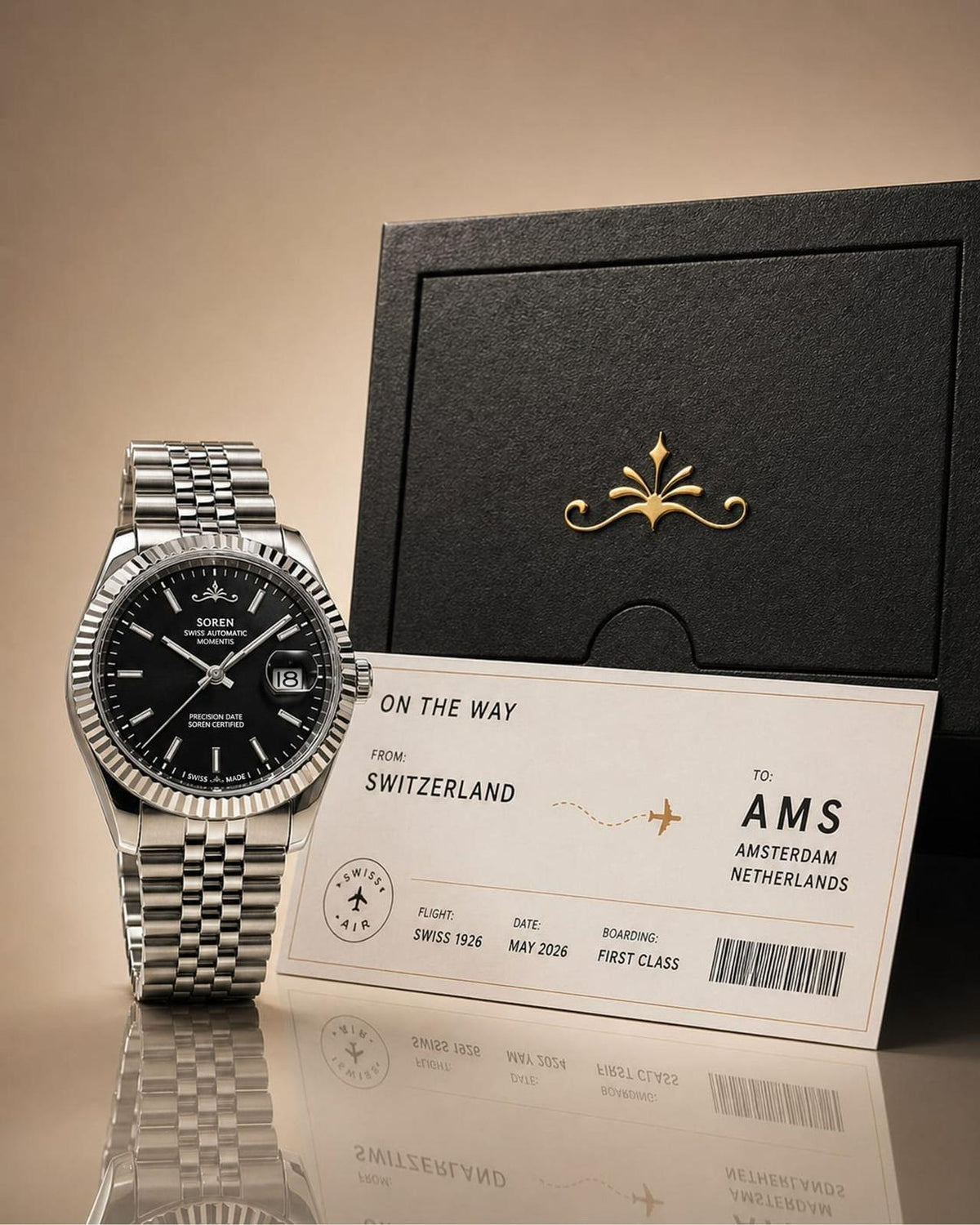
The Soren Oceanic includes a ceramic scratch-resistant bezel — a feature typically found on Swiss dive watches at €1,200 and above. The Soren Momentis includes sapphire crystal and a solid stainless steel case back, with no cost-cutting at the components that matter for daily wear.
What Japanese brands typically offer at €300–600:
Seiko Presage and Orient Star models in this range offer comparable finishing quality — in some cases, their dial craftsmanship exceeds equivalent Swiss options because Japanese dial-making has its own centuries-long tradition of lacquerwork and applied finishing.
The key difference at this price point is crystal: most Japanese watches below €500 use hardlex (a proprietary mineral crystal) rather than sapphire. Hardlex is more shatter-resistant than sapphire but significantly less scratch-resistant. Above €500, Japanese brands like Seiko Grand Seiko use sapphire — but Grand Seiko starts at €2,000+.
At equivalent prices, the Swiss option typically wins on crystal quality. The Japanese option often wins on dial artisanship.
Accuracy in Real Life: What the Numbers Mean
Sellita SW200: -4/+6 seconds per day
This means the watch will be within three minutes of correct time after a full month of wear without adjustment. In practice, most calibrated SW200 movements run within +2/+4 seconds per day — toward the positive end of the tolerance because watchmakers typically regulate slightly fast to account for positional variation.
Miyota 9015: -10/+30 seconds per day
The tolerance is wider — up to 30 seconds fast per day in the worst case. In practice, most Miyota 9015 movements run within -5/+15 seconds per day. That is still less than eight minutes per month, which is genuinely unnoticeable for most wearers who have a phone or computer nearby.
Seiko NH35: -20/+40 seconds per day
At the extreme, a watch could be 20 minutes slow after a month. For daily wear with a smartphone nearby, this is a non-issue. For someone who sets a watch and ignores it for weeks, it becomes relevant. The NH35 is best thought of as a watch you check and reset occasionally — which, for a €150–300 watch, is entirely reasonable.
The honest conclusion on accuracy:
For most people in most situations, the difference between an SW200 and a Miyota 9015 is unmeasurable without a timing machine. You will not feel it on your wrist. The SW200 has a tighter specification — which matters if you are particular about accuracy or if you are buying a watch as a precision instrument rather than a lifestyle accessory.
Water Resistance: An Underappreciated Difference
Water resistance is determined by case construction, not by the movement. But it is worth including in any Swiss vs Japanese comparison because it reveals different design philosophies at similar price points.
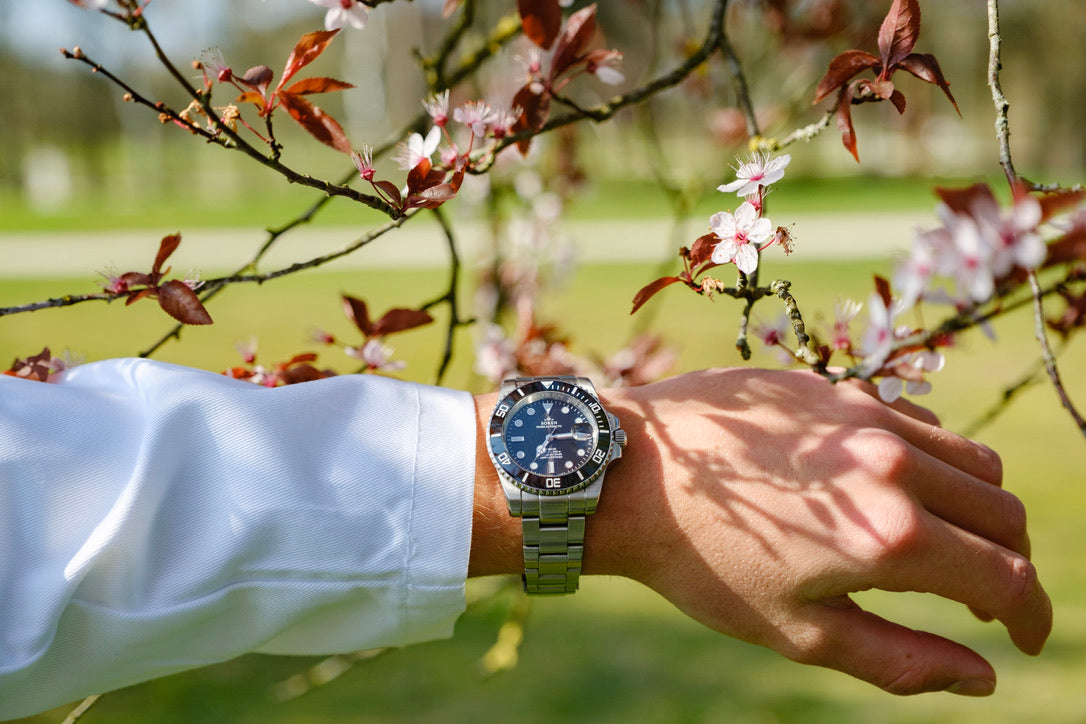
The Soren Oceanic offers 30 ATM (300 metres) water resistance — professional dive watch standard — with a ceramic bezel and a screw-down crown at €695.
A comparable Seiko Prospex diver at 20 ATM costs approximately €600–800 through a Dutch dealer — similar price, slightly lower specification. The Seiko has the advantage of Seiko's long diving heritage; the Soren has ceramic bezel and ceramic bezel scratch resistance that Seiko offers only at higher price points.
For the Soren Momentis, 10 ATM is the standard — sufficient for swimming and showering, appropriate for an everyday automatic.
Servicing in the Netherlands: A Practical Consideration
For Dutch buyers specifically, service availability is a relevant factor in the Swiss vs Japanese decision.
Swiss Made watches: The Sellita SW200 is one of the most commonly serviced movements in European watchmaking. Any certified watchmaker in Amsterdam, Rotterdam, Eindhoven, Utrecht, or Den Haag can service it. Parts are available through established European supply chains. A full service costs approximately €150–250 and is recommended every five to seven years.
Japanese movements: The Miyota 9015 is also widely serviced in Europe — it is common enough that most independent watchmakers have experience with it. The NH35 is similarly widespread. Service costs are lower — €80–150 for the Miyota 9015 — which is a genuine advantage if you intend to service regularly.
The long-term calculation: A Soren Momentis at €625, serviced once every six years at €200, costs €825 over ten years. A Miyota 9015 watch at €500, serviced every four years at €120, costs €740 over ten years. An NH35 watch at €300, serviced every three years at €75, costs €525 over ten years.
The price gap narrows significantly when total cost of ownership is factored in. The Swiss option is not always the most expensive choice over a decade.
For more on what Swiss Made watch ownership costs over time, see our Buying a Swiss Made Watch in the Netherlands guide.
The Gift Question: Swiss Made vs Japanese for an Occasion
If you are buying a watch as a gift — for a graduation, a milestone birthday, a promotion — the Swiss Made label carries weight that a Japanese movement does not. Not because the quality is meaningfully different at this price point, but because "Swiss Made" communicates something that "Japanese automatic" does not to a non-watch-collector recipient.
For a gift buyer, the Swiss Made label is part of the value proposition. For a watch enthusiast who knows the Miyota 9015 well, it is less relevant.
For gift ideas and occasion-specific advice, read our Why a Swiss Made Watch is the Perfect Gift guide.
Who Makes the Best Independent Swiss Watch Brands at This Price?
The Swiss Made landscape at €600–800 includes several independent brands worth knowing alongside Soren. For a full overview, read our 7 Independent Swiss Watch Brands Worth Knowing in 2026 — which covers brands from Halios to Monta to Norqain.
The Verdict: Which Should You Buy?
Choose a Swiss Made automatic watch if:
- The Swiss Made certification matters to you — as a quality signal, a gift signal, or a provenance statement
- You prefer a European service network — important for watches bought and worn in the Netherlands
- Accuracy specification is a priority and you want the tighter tolerance of the SW200
- You value a longer service interval — fewer workshop visits over a decade
- You are buying for an occasion where provenance matters
Choose a Japanese automatic if:
- Power reserve is your priority — the Miyota 9015's 42 hours is a genuine advantage for irregular wearers
- Your budget is under €500 and you want a proven movement — the NH35 is outstanding at that price level
- You prefer Seiko's in-house design philosophy and track record
- Dial artisanship matters more to you than movement specification — Japanese dial-making is world-class
At the €625–695 price point of a Soren Oceanic or Momentis: The SW200 is the strongest movement available in Swiss Made format at this price. There is no Japanese equivalent at the same price that offers equivalent accuracy specification, Swiss certification, and ceramic bezel — all simultaneously.
That is not a dismissal of Japanese watchmaking. It is an honest assessment of what €625 buys in each tradition.
Frequently Asked Questions
Is the Sellita SW200 better than the Miyota 9015? On accuracy specification, yes — -4/+6 vs -10/+30 seconds per day. On power reserve, no — the Miyota offers 42 hours versus 38. For most wearers, the practical difference is negligible. The SW200 adds Swiss Made certification, which the Miyota cannot offer.
Can a Swiss Made watch be serviced in Japan? Yes — the SW200 is serviced globally. Conversely, Japanese movements are serviced across Europe. Service geography is not a deciding factor for either tradition.
Is Seiko Grand Seiko comparable to Swiss Made? Grand Seiko starts at €2,000 and uses in-house movements with finishing that rivals Swiss brands at €5,000+. It is not a direct comparison to an SW200-based watch at €625 — it is a different tier entirely.
What is the best Swiss Made watch under €700? The Soren Oceanic and Soren Momentis offer the strongest specification at this price point from a direct-to-consumer Swiss Made brand. For a full comparison of options, read our Complete Guide to Swiss Made Watches Under €700.
Is Swiss Made always better than Japanese? No. At equivalent prices, the choice depends on what you value — Swiss certification, accuracy specification, and European serviceability versus Japanese reliability, power reserve, and occasionally superior dial finishing. This guide should help you decide which matters more to you.
Discover the Soren Momentis — Sellita SW200-1, Swiss Made automatic from €625 Shop the Momentis
Discover the Soren Oceanic — Sellita SW200, Swiss Made dive watch from €695 Shop the Oceanic


Leave a comment
This site is protected by hCaptcha and the hCaptcha Privacy Policy and Terms of Service apply.