
Most people can glance at a watch and tell the time. But understanding what you're actually looking at — the names of each element, what the markings mean, why certain watches show more information than others — is a different skill entirely.
This guide covers everything. By the end, you'll be able to look at any watch dial and know exactly what you're seeing.
The Basics: What Is a Watch Dial?
The dial is the face of the watch — the part you look at to read the time. Everything printed, painted, or applied onto that surface is part of the dial. The word comes from the Latin dialis, meaning daily, referring to the daily rotation of the sun.
A dial can be simple — just hour markers and hands — or complex, showing the date, day, moon phase, second time zone, and more. The complexity of the information displayed is what watchmakers call complications.
But before complications, you need to understand the basics.
Hour Markers: How the Dial Is Divided
The dial is divided into 12 sections, each representing one hour. Those sections are marked in one of several ways:
Arabic numerals — the standard 1 through 12, used on casual and sports watches. Easy to read at a glance.
Roman numerals — I through XII, traditionally used on dress watches. Associated with heritage and formality.
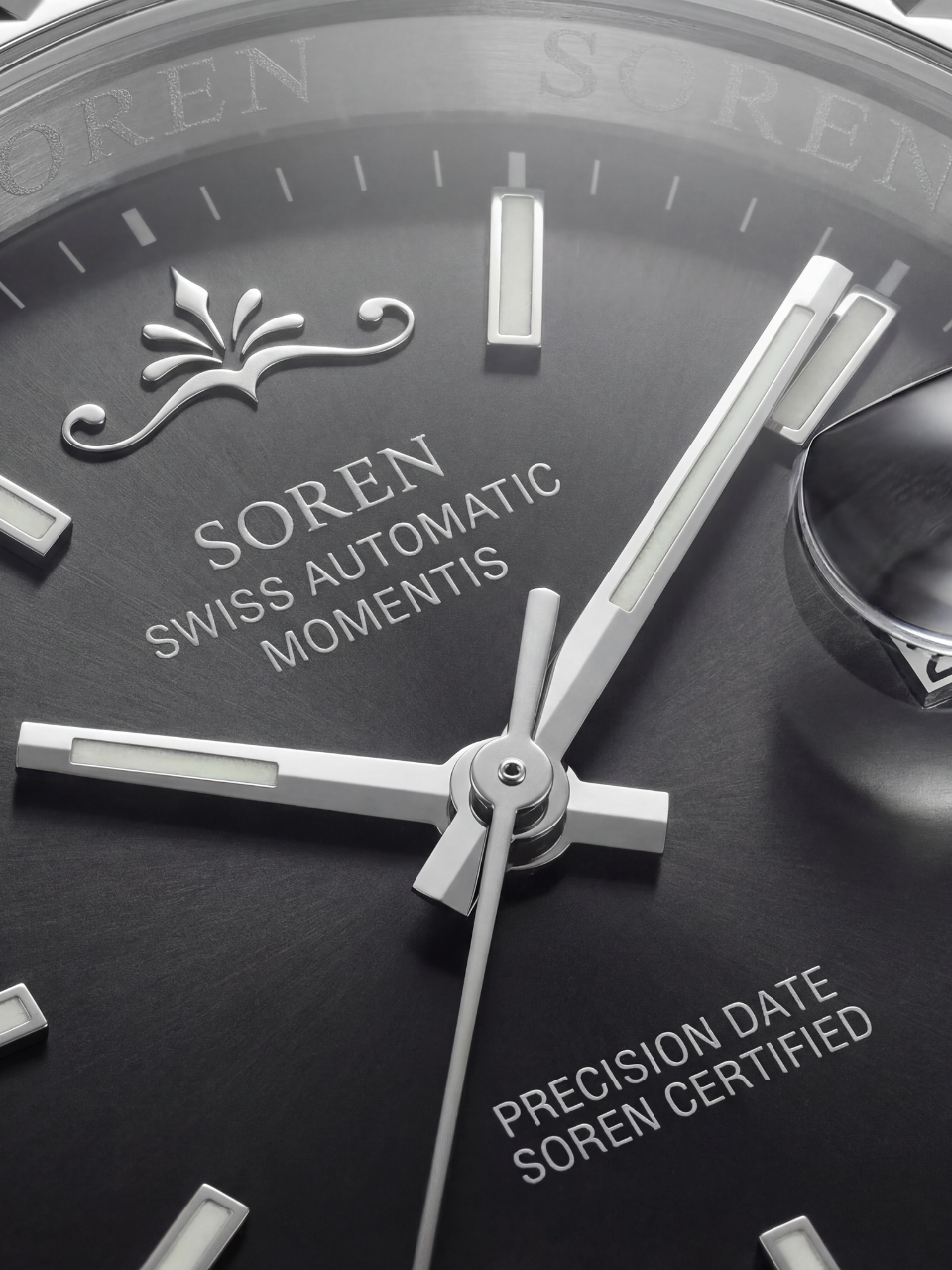
Stick indices — thin rectangular markers with no numbers. Clean and minimal. Used on dress watches and modern sport watches, including the SOREN Momentis and Oceanic.
Dot indices — small circular markers. Common on dive watches and tool watches.
Applied indices — markers that are physically attached to the dial rather than printed onto it. They catch the light differently and give a watch a more premium, three-dimensional look.
The choice of hour marker is one of the most significant design decisions on any watch. Stick indices like those on the Momentis communicate confidence without noise — you know what time it is without having to interpret anything.
The Hands: What Each One Does
A standard watch has three hands. Understanding each one is straightforward once you know what to look for.
The hour hand is the shortest and moves slowest. It completes one full revolution every 12 hours.
The minute hand is the longest. It completes one revolution every 60 minutes, pointing directly to the 12 when the hour changes.
The seconds hand is the thinnest and fastest, completing one full revolution every 60 seconds. On automatic watches, it moves in a smooth continuous sweep — this is called a sweep seconds hand and is one of the clearest signs of a mechanical movement. Quartz watches typically tick once per second.
On the SOREN Momentis and Oceanic, the seconds hand sweeps continuously — powered by the Sellita SW200-1 automatic movement beating at 28,800 vibrations per hour. That smooth sweep is impossible to fake with a quartz movement.
If you want to understand more about the difference between automatic and quartz movements, we covered it in detail in our guide to Swiss Made vs Japanese automatic watches.
Reading the Time: A Step-by-Step Guide
If you're looking at an analogue watch for the first time, here is exactly how to read it:
Step 1: Look at the hour hand — the short one. Note which number or marker it's closest to. That tells you the approximate hour.
Step 2: Look at the minute hand — the long one. Count the marker it's pointing to. Each marker represents 5 minutes. So if it points to the 3, that's 15 minutes past the hour. If it points to the 9, that's 45 minutes past (or 15 minutes to the next hour).
Step 3: For precision, look at the seconds hand to see where you are within the current minute.
Example: Hour hand just past the 10, minute hand at the 2 (which is 10 minutes), seconds hand at the 30. That's 10:10 and 30 seconds.
The Bezel: More Than Just a Frame
The bezel is the ring that surrounds the crystal — the glass over the dial. On many watches it's purely decorative, but on sport and tool watches it serves a specific function.
Smooth bezel — decorative only. Common on dress watches.
Fluted bezel — a bezel with vertical grooves cut into it, originally designed to make the watch easier to screw down. Now primarily aesthetic. The SOREN Momentis features a fluted bezel — a design associated with precision watchmaking.
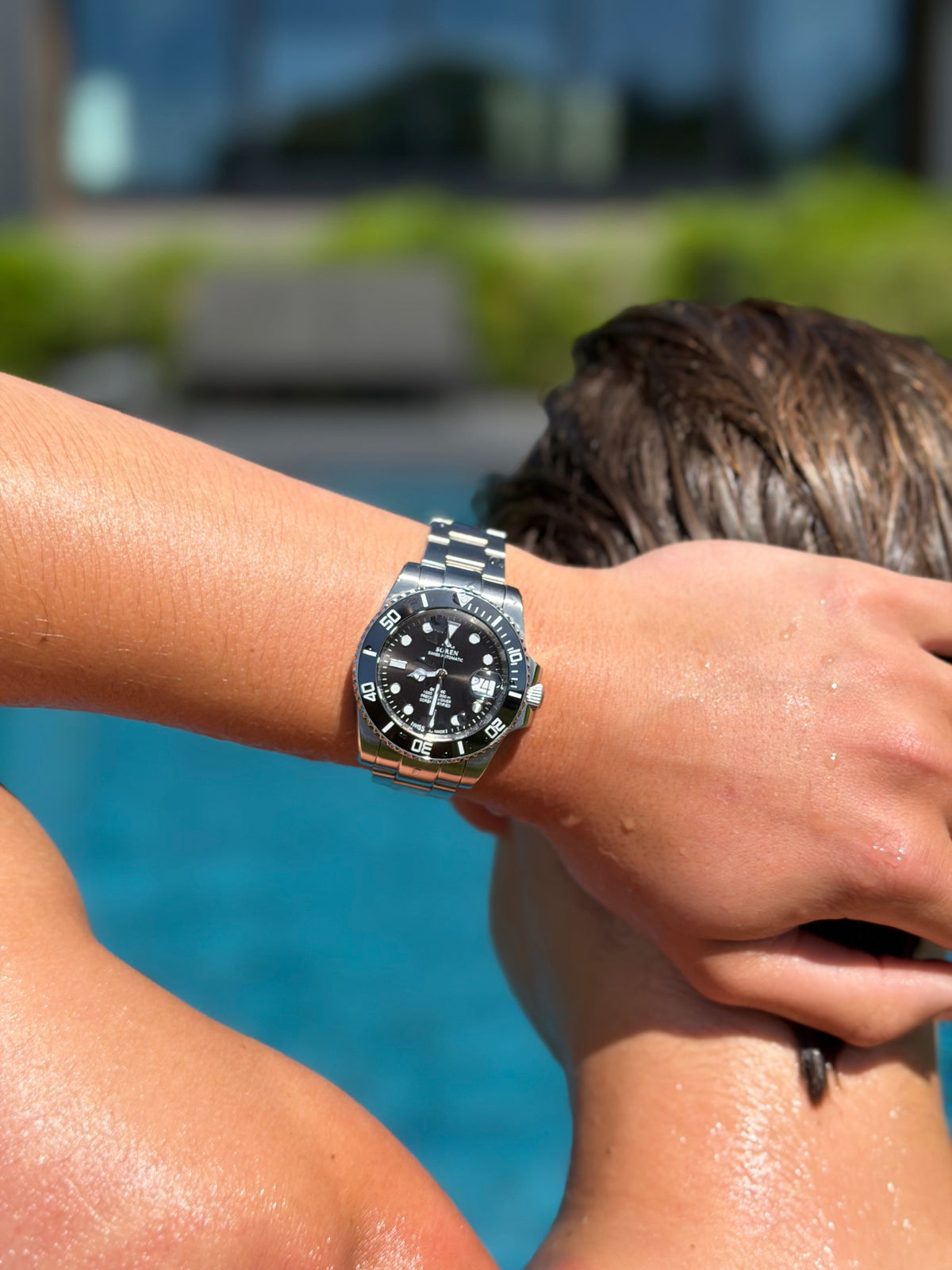
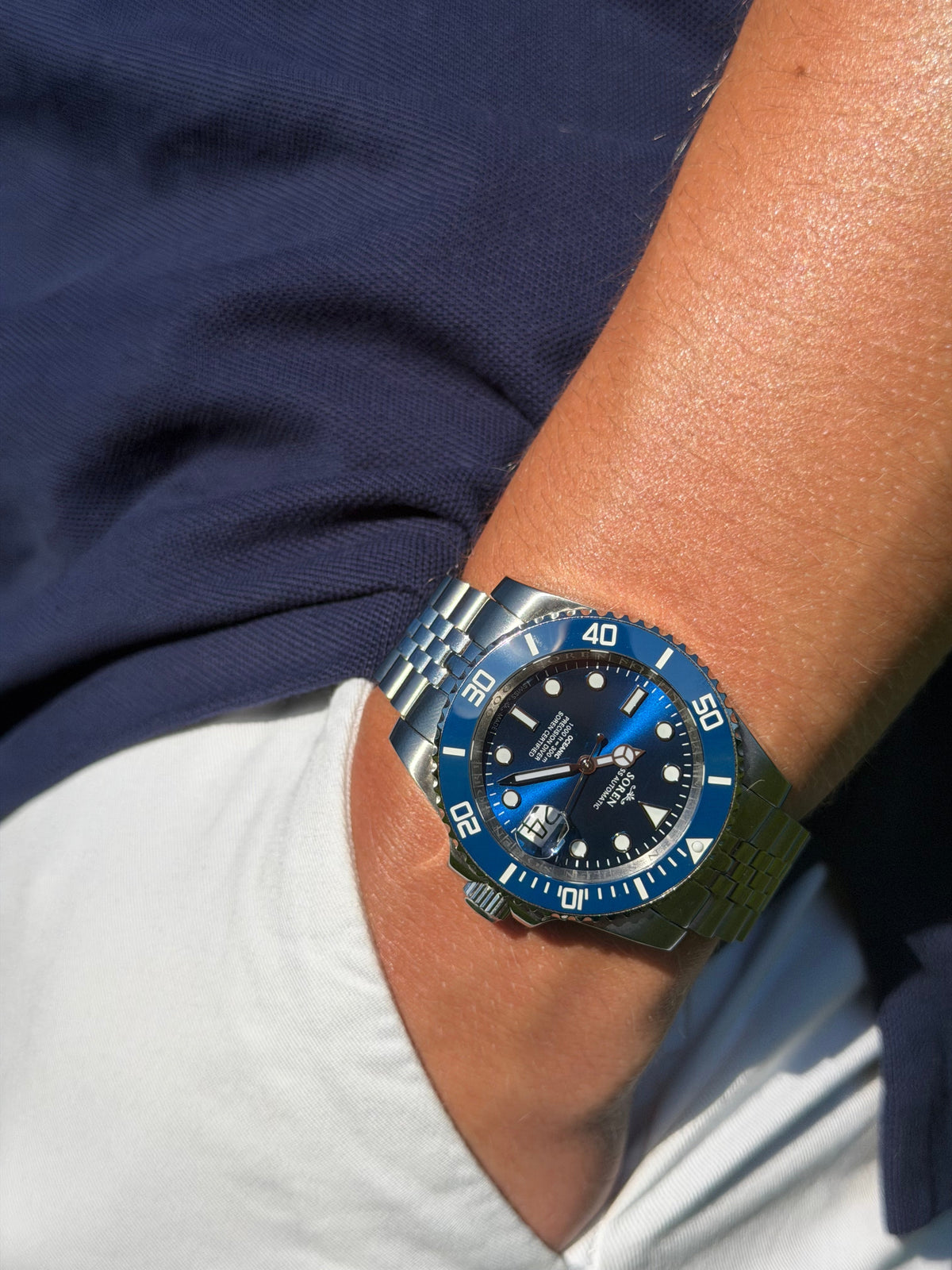
Unidirectional rotating bezel — found on dive watches. Can only rotate counterclockwise. Used to track elapsed dive time safely. The SOREN Oceanic has a unidirectional bezel for this reason. If you want to understand water resistance and dive watch specifications in detail, read our guide to watch water resistance and ATM ratings.
Bi-directional rotating bezel — found on GMT watches, used to track a second time zone.
Fixed tachymeter bezel — found on chronograph watches, used to calculate speed over a measured distance.
The Crown: The Small Knob on the Side
The crown is the small knob on the right side of the case, typically at the 3 o'clock position. It has several functions depending on how far you pull it out.
Position 0 (pushed in): Normal operating position. On watches with a screw-down crown — like the SOREN Oceanic — you unscrew it first before pulling it out. The screw-down crown is part of what gives the Oceanic its 300M water resistance.
Position 1 (first click out): Used to set the date (on watches with a date display).
Position 2 (second click out): Used to set the time. Pull to this position, set the hands, then push back in and screw down if applicable.
Never pull the crown while the watch is submerged in water.
The Crystal: What Covers the Dial
The crystal is the transparent cover over the dial. There are three main types:
Acrylic crystal — plastic. Scratches easily but can be polished. Found on vintage watches and budget pieces.
Mineral crystal — hardened glass. More scratch resistant than acrylic but can crack under impact.
Sapphire crystal — synthetic sapphire. Rated 9 on the Mohs hardness scale (diamond is 10). Extremely scratch resistant. The standard for quality watchmaking. Both the SOREN Momentis and Oceanic use sapphire crystal.
The difference in daily life is significant. A mineral crystal watch will show fine scratches within months of daily wear. A sapphire crystal watch will stay clear for years under the same conditions.
Complications: Everything Beyond the Time
A complication is any function on a watch beyond the display of hours and minutes. The word sounds intimidating but the concept is simple — it refers to the additional mechanical complexity required to display the extra information.
Date display — the most common complication. Shows the current date, typically through a small window at the 3 o'clock or 6 o'clock position. Both the Momentis and Oceanic display the date at 3 o'clock.
Day-date — shows both the day of the week and the date. Requires more movement complexity.
Chronograph — a stopwatch function. Has additional pushers on the side of the case and additional subdials on the face. Not to be confused with a regular watch.
GMT — shows a second time zone via an additional hand and a rotating bezel or additional subdial. Originally developed for pilots and frequent travellers.
Moon phase — displays the current phase of the moon through a rotating disc visible through an aperture in the dial. One of the most visually striking complications in watchmaking. The upcoming SOREN SELENE will feature a moonphase complication driven by the Sellita SW285-1.
Power reserve indicator — shows how much energy is left in the mainspring before the watch needs winding. Useful for automatic watches that are worn intermittently.
Tourbillon — a rotating cage that holds the escapement to counteract the effects of gravity. The most complex complication in traditional watchmaking. Found on very high-end pieces.
For most buyers, a date display is the only complication you'll use daily. Everything else is a matter of interest and preference.
Lume: Reading Your Watch in the Dark
Luminescent material — called lume — is applied to the hands and hour markers so the watch can be read in low light or darkness. Modern lume is photoluminescent: it absorbs light during the day and emits it in the dark.
The most common modern lume is Super-LumiNova, a Swiss-made photoluminescent pigment. It glows green or blue depending on which grade is used.
The quality and quantity of lume varies significantly between watches. Dive watches tend to have more substantial lume applications because readability underwater in low visibility is a safety requirement.
Subdials: Small Dials Within the Dial
Subdials are smaller dials contained within the main dial face. They typically display secondary information — seconds, elapsed minutes on a chronograph, a second time zone, or a power reserve.
A watch with multiple subdials is sometimes called a panda dial (black subdials on white dial) or reverse panda (white subdials on black).
The presence of subdials significantly changes the visual balance of a dial. A clean dial with no subdials reads as more minimal and modern. A dial with multiple subdials reads as more technical and tool-oriented.
Water Resistance Markings
Many watches display their water resistance rating on the dial or caseback. Understanding these numbers matters if you plan to wear your watch anywhere near water.
30M / 3 ATM — splash resistant only. Do not swim with this watch.
50M / 5 ATM — suitable for swimming in shallow water. Not for diving.
100M / 10 ATM — suitable for swimming and snorkelling. The SOREN Momentis is rated to 100M.
200M / 20 ATM — suitable for recreational scuba diving.
300M / 30 ATM — suitable for professional diving and water sports. The SOREN Oceanic is rated to 300M.
For a complete explanation of what these numbers mean in real-world use, read our guide to watch water resistance explained.
The Caseback: What's Behind the Dial
The caseback is the reverse side of the watch case — the part that sits against your wrist. There are two main types:
Solid caseback — opaque stainless steel. Protects the movement and typically features engravings — the brand name, model, serial number, and water resistance rating. Both the Momentis and Oceanic have solid casebacks.
Exhibition caseback — a transparent sapphire or mineral glass panel that lets you see the movement inside the watch. Popular on watches with particularly attractive movements. The Sellita SW200-1 inside the Momentis and Oceanic is a well-finished movement — the kind that earns an exhibition caseback on many watches costing significantly more.
Swiss Made: What It Means on the Dial
If a watch dial reads Swiss Made, it carries a specific legal meaning. The watch must meet requirements set by Swiss federal law: the movement must be Swiss, assembled in Switzerland, and the final inspection must take place in Switzerland. At least 60% of manufacturing costs must originate in Switzerland.
It is not a marketing term. It is a certification. Both the SOREN Momentis and Oceanic carry Swiss Made certification — a standard that guarantees the quality of what's inside.
For a detailed explanation of what Swiss Made means and why it matters, read our guide to Swiss Made watches vs Japanese automatics.
Choosing Your First Watch: What to Look For on the Dial
Now that you understand what you're looking at, here is what actually matters when choosing a watch:
Legibility — can you read the time quickly and easily? Clean dials with stick indices and contrasting hands score highest here.
Dial colour — black dials are the most versatile. Blue dials are a strong second. Green is increasingly popular. Champagne and white work on dress watches.
Complications — only add complications you'll actually use. A date is useful. A chronograph is impressive but most people never use it.
Crystal — insist on sapphire. You'll notice the difference within the first week of wear.
Movement — for a first serious watch, an automatic movement is worth the extra cost. The experience of wearing a mechanical watch that you never need to charge is genuinely different.
For a complete guide to choosing your first automatic watch, read our full beginner's guide: How to Choose Your First Automatic Watch.
The SOREN Momentis and Oceanic: Applied to This Guide
Everything covered in this guide is present on the SOREN Momentis and Oceanic.
The Momentis features a clean dial with stick indices, fluted bezel, sapphire crystal, date at 3 o'clock, and a sweep seconds hand powered by the Sellita SW200-1. 100M water resistance. Available in five dial colours on 3-link or 5-link bracelet.
The Oceanic adds a unidirectional ceramic bezel and 300M water resistance — purpose-built for water use while maintaining the same clean aesthetic as the Momentis.
Both are Swiss Made certified. Both start from €625.
View the SOREN Momentis → View the SOREN Oceanic →
If you're trying to decide between the two, our guide to choosing between the Momentis and Oceanic covers the key differences in detail.
Free shipping across Europe. 2-year warranty included. 30-day returns.


Leave a comment
This site is protected by hCaptcha and the hCaptcha Privacy Policy and Terms of Service apply.