
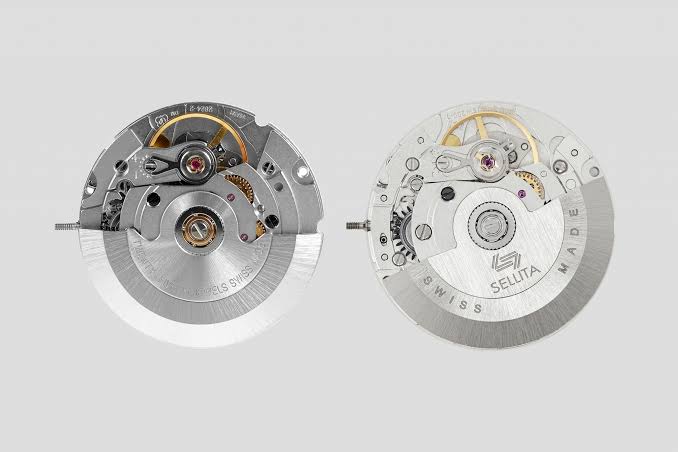
Two of the most common movements in accessible Swiss watchmaking are the ETA Powermatic 80, found in Tissot and other Swatch Group watches, and the Sellita SW200, found across a huge range of independent brands. If you are comparing watches, you are probably comparing these two movements, whether you realise it or not.
This guide compares them honestly. And the honest headline is this: neither movement wins outright. They make different choices, and which one is right depends on what you value. Anyone who tells you one is simply better than the other is selling something.
Quick Answer
The Powermatic 80 offers a longer power reserve of 80 hours. The Sellita SW200 offers a higher beat rate of 28,800 bph, giving a smoother seconds sweep. Both are Swiss Made, both are reliable, and both will last decades with servicing.
If you prioritise a long power reserve, the Powermatic 80 has the edge. If you prioritise a traditional high beat rate and a fluid seconds sweep, the SW200 has the edge. It is a genuine trade-off, not a case of one being superior.
The Sellita SW200 is the movement in both current Soren models. Here is how it compares to Tissot's Powermatic 80 across every meaningful measure.
Power Reserve: 80h vs 38-42h
This is the Powermatic 80's clearest advantage, and it is a real one.
The Powermatic 80 is named for its power reserve: 80 hours. Fully wound, it will run for more than three days off the wrist. Take the watch off on Friday and it will still be running on Monday, or even Tuesday. For anyone who rotates between watches or does not wear a watch every day, this is genuinely convenient.
The standard Sellita SW200-1 offers 38 to 42 hours. That is a little over a day and a half. Take it off Friday evening and it will have stopped by Sunday, meaning you reset it come Monday.
On this measure, the Powermatic 80 wins clearly. If a long power reserve is the single most important thing to you, this is the movement that delivers it. It is worth noting, though, that Sellita's 2026 SW200-2 Power+ upgrade raises the SW200's reserve to 65 hours, closing most of this gap while keeping its other advantages.
Beat Rate: 21,600 vs 28,800 bph
Here is where the SW200 has its advantage, and where the Powermatic 80's longer reserve comes at a cost most marketing does not mention.
The Sellita SW200 runs at 28,800 beats per hour, which is 4 Hz. This is the traditional high beat rate for a quality mechanical movement. It gives the seconds hand a smooth, fluid sweep and contributes to strong rate stability.
The Powermatic 80 runs at 21,600 beats per hour, which is 3 Hz. This lower frequency is one of the ways ETA achieves that 80-hour power reserve: a slower-beating movement uses less energy, so the same mainspring lasts longer. The trade-off is that the seconds hand sweeps in slightly more visible steps rather than the smoother glide of a 4 Hz movement.
Whether you notice or care about this is personal. Some people never look closely enough to see the difference. Others, once they notice it, cannot unsee it. But it is a real difference, and it is the direct cost of the Powermatic 80's longer reserve. The SW200 keeps the traditional high beat rate; the Powermatic 80 trades some of it away for endurance.
Where Each Is Used
The two movements live in different parts of the industry, and this is not an accident.
The Powermatic 80 is an ETA movement. ETA is owned by the Swatch Group, and since the early 2000s it has restricted the sale of its movements largely to brands within the group. So the Powermatic 80 is found in Swatch Group brands: Tissot, where it powers the popular PRX and Seastar, along with Certina, Mido, and others in the group.
The Sellita SW200 is found almost everywhere else. Sellita was created specifically to supply the movements that ETA stopped selling to outside brands. Today the SW200 powers a vast range of independent Swiss watch brands, including Soren. It is the default movement of independent Swiss watchmaking.
This is why the comparison so often comes down to Tissot versus an independent brand. You are frequently comparing a Powermatic 80 watch against an SW200 watch, which is really a comparison between the Swatch Group model and the independent model. That broader comparison is covered in the independent brand versus Tissot guide.
The Real Trade-Off Nobody Mentions
Marketing tends to present the Powermatic 80's 80-hour reserve as a straightforward win. It is not. It is a trade, and here is the full picture.
To get 80 hours, ETA lowered the beat rate to 3 Hz. That means a less fluid seconds sweep and, historically, some Powermatic 80 movements have used a plastic (Nivachron or similar synthetic) escapement and a regulation system that some watchmakers find less traditional to adjust than the SW200's fully metal, conventionally regulated construction.
The SW200 keeps the traditional 4 Hz beat rate and a conventional, fully serviceable construction that any watchmaker has worked on for decades. Its cost is the shorter power reserve.
So the honest framing is this. The Powermatic 80 buys endurance at the cost of beat rate and, arguably, traditional construction. The SW200 keeps the beat rate and the traditional build at the cost of endurance. Neither is a free win. Both are legitimate engineering choices, and both result in reliable, long-lasting movements.
Which Is Right for You?
Here is how to decide, honestly.
Choose the Powermatic 80 if the power reserve is your priority. If you take your watch off for whole weekends, rotate between several watches, or simply hate resetting the time, 80 hours is genuinely useful and the movement delivers it better than the standard SW200.
Choose the Sellita SW200 if you value the traditional 4 Hz beat rate and a smooth seconds sweep, and you want the movement with the longest track record of conventional serviceability. If you wear the watch most days, the shorter power reserve rarely matters, because daily wear keeps it wound, and you get the smoother sweep as a daily benefit.
And if you want both a long reserve and the high beat rate, that option now exists: the SW200-2 Power+ delivers 65 hours at the full 28,800 bph, which is arguably the strongest combination of the three.
For most people who wear their watch regularly, the movement matters far less than the watch it sits inside. Both of these are excellent, proven calibres. The watch's design, materials, and value matter more than which of these two reliable movements is inside.
FAQ
Does a lower beat rate mean less accurate?
Not necessarily. Beat rate and accuracy are related but not the same thing. A higher beat rate (28,800 bph) can offer marginally better rate stability because the balance oscillates more frequently, but a well-regulated 21,600 bph movement like the Powermatic 80 is still accurate to within a few seconds per day. In practice, the accuracy difference between the two is small; the more visible difference is the smoothness of the seconds sweep, not the timekeeping.
Which movement is easier to service?
The Sellita SW200 has a slight edge here. It uses a traditional, fully metal, conventionally regulated construction that watchmakers have serviced for decades, and its parts are widely available. The Powermatic 80 is also serviceable, but some of its components and its regulation system are less traditional, and it is more closely tied to the Swatch Group service network. For independent watchmaker servicing, the SW200 is generally the more straightforward of the two. Full detail is in the SW200 service guide.
Is the Powermatic 80 exclusive to Tissot?
Not exclusive to Tissot, but largely exclusive to the Swatch Group. The Powermatic 80 is an ETA movement, and ETA is owned by the Swatch Group, which restricts sales mostly to its own brands. So you will find the Powermatic 80 in Tissot, Certina, Mido, and other Swatch Group names, but not in independent brands. Independent brands use the Sellita SW200 instead.
Which is better, the Powermatic 80 or the SW200?
Neither is objectively better. The Powermatic 80 offers a longer 80-hour power reserve; the SW200 offers a higher 28,800 bph beat rate with a smoother seconds sweep and more traditional serviceability. It is a trade-off. The right choice depends on whether you value endurance or beat rate, and for most daily wearers the difference is small.
Do both movements last a long time?
Yes. Both are Swiss Made movements built to be serviced and to last for decades. With regular servicing every few years, either movement will run reliably for a very long time. Longevity is not a meaningful point of difference between them.
Which movement does Soren use?
Both current Soren models, the Momentis and the Oceanic, use the Sellita SW200-1 at 28,800 bph. This gives them the smooth high-beat seconds sweep and the traditional, widely serviceable construction. You can read exactly how accurate it is in the SW200 accuracy guide.
The Bottom Line
The Powermatic 80 and the Sellita SW200 are both excellent Swiss Made movements, and neither wins outright. The Powermatic 80 offers a longer 80-hour power reserve, achieved by dropping to a 21,600 bph beat rate. The SW200 keeps the traditional 28,800 bph beat rate and a smoother seconds sweep, at the cost of a shorter power reserve.
It is a genuine trade-off between endurance and beat rate. If you want the longest reserve, the Powermatic 80 delivers it. If you want the traditional high beat and the most straightforward serviceability, the SW200 delivers that. And if you want both, Sellita's new SW200-2 Power+ now offers 65 hours at the full 28,800 bph.
For most people, the movement matters less than the watch around it. Both are reliable, proven calibres that will run for decades. What matters more is the design, the materials, and the value of the watch they sit inside.
Free EU shipping. 2-year warranty. 30-day returns. Swiss Made. sorenwatches.com



Leave a comment
This site is protected by hCaptcha and the hCaptcha Privacy Policy and Terms of Service apply.