
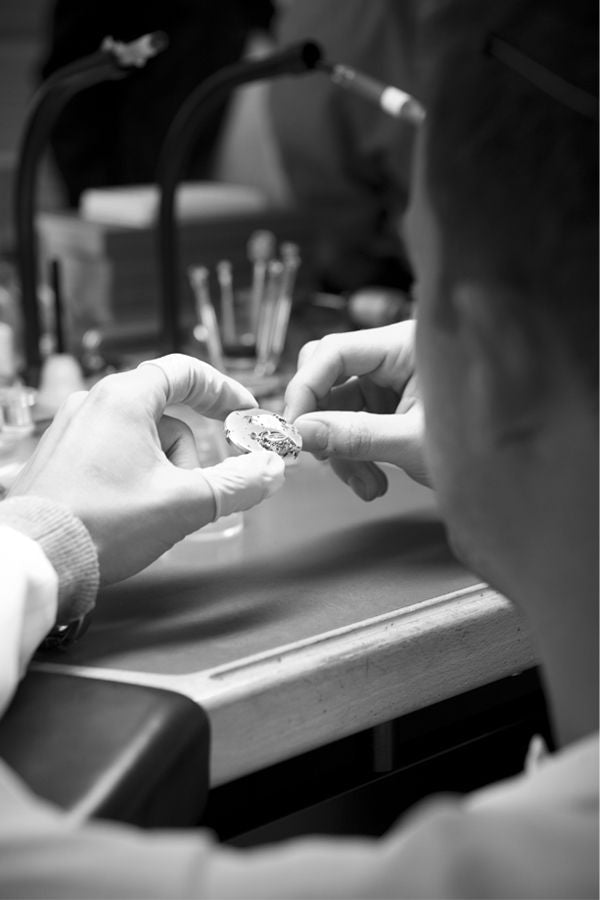
An automatic watch is a mechanical instrument. Like any mechanism with moving parts and lubrication, it benefits from periodic maintenance. The Sellita SW200 is one of the most serviceable movements in Swiss watchmaking, which is one of the reasons it powers watches from hundreds of brands, including both the SOREN Momentis and the SOREN Oceanic.
This guide explains when a Sellita SW200 needs servicing, what a service involves, what it costs, and what you can do yourself to keep the movement running well between services. It is written for the owner, not the watchmaker: practical, honest, and free of unnecessary technical detail.
What "Servicing" Actually Means
A watch service is not a repair. It is preventive maintenance. Over time, the lubricants inside a mechanical movement degrade. They dry out, migrate away from where they are needed, and lose their ability to reduce friction. When that happens, the metal parts of the movement begin to wear against each other. Left long enough, this wear causes parts to fail.
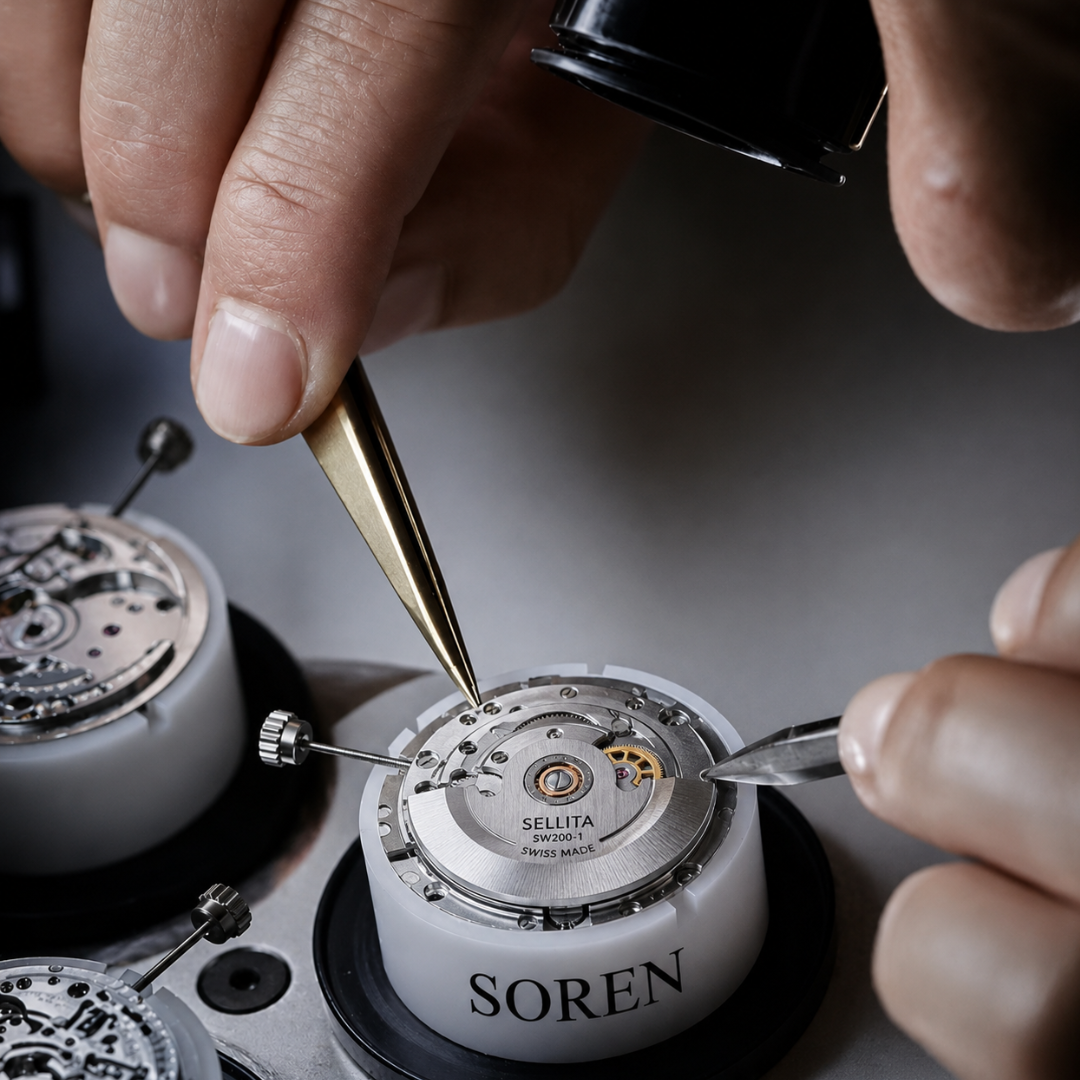
A full service reverses this process before wear becomes damage. A watchmaker disassembles the movement completely, cleans every component, inspects for wear, replaces any worn parts, applies fresh lubricant at the specified points, reassembles the movement, and regulates it for accuracy. The result is a movement that performs as it did when new.
For the Sellita SW200, this is a routine, well-understood procedure that any competent watchmaker can perform. The movement's design and its widespread use mean that parts are readily available and the servicing process is familiar to professionals worldwide.
When Does a Sellita SW200 Need Servicing?
The standard recommendation for the Sellita SW200 is a full service every three to five years. Some owners and watchmakers extend this to five to seven years depending on wear conditions and how the watch is used.
The honest answer is that it depends on several factors, and there is no single correct interval.
Usage. A watch worn daily keeps its mainspring wound and its movement running consistently, which actually helps keep lubricants distributed. A watch that sits unused for long periods can have lubricants pool and dry unevenly.
Environment. Exposure to moisture, extreme temperature swings, dust, and strong magnetic fields all accelerate the need for service. A watch worn in a stable indoor environment will go longer between services than one exposed to harsh conditions.
Accuracy tolerance. How much deviation you are willing to accept affects when you service. If you want your watch to stay within a few seconds per day, you will service sooner. If you are comfortable with a watch that drifts more noticeably, you can wait longer.
The most reliable approach is to watch for the signs rather than to service purely on a fixed calendar schedule.
Signs Your SW200 Needs a Service
Rather than servicing blindly on a schedule, pay attention to how the watch behaves. The following are the clearest indicators that a service is due.
Increased timekeeping deviation. If your watch was keeping good time and now runs consistently fast or slow by more than around 20 seconds per day, the lubrication is likely degrading. A movement that once ran at +3 seconds per day and now runs at -20 or worse is signalling that a service is due.
Reduced power reserve. If your fully wound watch used to run for its full power reserve but now stops well short, the mainspring or the going train may need attention. A noticeable drop in how long the watch runs off the wrist is a service signal.
Rotor noise or roughness. The automatic winding rotor should spin smoothly and quietly. If you hear grinding, rattling, or feel roughness when the rotor turns, the rotor bearing may be wearing. On the SW200, a known issue is the "helicopter effect," where the rotor spins when you hand-wind the watch. This is caused by dried lubricant in the reversing wheels and is a clear service indicator.
Moisture under the crystal. Any condensation or fogging inside the crystal means the seals have been compromised and moisture has entered the case. This requires immediate attention, not just a routine service, because moisture causes corrosion.
Difficulty setting or winding. If the crown feels gritty, stiff, or inconsistent when winding or setting, the keyless works may need cleaning and lubrication.
If you notice any of these, book a service. If you notice none of them and the watch is running well within specification, there is a reasonable argument for waiting, provided you are not approaching the far end of the recommended interval.
What a Service Costs
For a Sellita SW200, a full service typically costs between €80 and €150 through an independent watchmaker, depending on the region and the watchmaker's rates. Some watchmakers charge slightly more if parts need replacing, and gasket replacement for water resistance is usually included or added at minimal cost.
This is one of the practical advantages of the SW200. Because it is so widely used and its parts are readily available, servicing is affordable relative to proprietary in-house movements, which can cost several hundred euros to service and sometimes require sending the watch back to the manufacturer.
For context, servicing an in-house movement from a luxury brand can cost €400 to €800 or more, and can take months if the watch must be sent to a brand service centre. A Sellita SW200 can be serviced by a local independent watchmaker in a matter of weeks at a fraction of that cost. This serviceability is a genuine long-term ownership benefit that is easy to overlook at the point of purchase.
It is also worth noting that the entire SW200 movement can be replaced for roughly €200 to €300 if a catastrophic failure ever occurred, though this is rarely necessary. In most cases, a service restores the existing movement to full working condition.
Do You Service Through SOREN or a Local Watchmaker?
For SOREN owners specifically, routine servicing does not need to go through SOREN. The SW200 is a standard Swiss movement that any qualified watchmaker can service. You are free to use a trusted local watchmaker, which is often faster and more convenient than sending the watch away.
SOREN's 2-year warranty covers manufacturing defects and movement malfunctions. This is separate from routine servicing, which is standard maintenance and not a defect. If your watch develops a fault within the warranty period that is caused by a manufacturing issue, that is covered. Routine servicing after years of normal wear is standard maintenance that the owner arranges.
If you are ever unsure whether an issue is a warranty matter or a servicing matter, contact support@sorenwatches.com with a description and we will help you determine the right path.
What You Can Do Yourself Between Services
You cannot and should not attempt to service the movement yourself unless you are a trained watchmaker. Opening the caseback and disturbing the movement risks damage and voids the warranty. But there are several things you can do to extend the interval between professional services and keep the watch running well.
Wear it. The single best thing you can do for an automatic movement is to wear it regularly. Wearing the watch keeps the mainspring wound and the lubricants distributed. A watch that is worn daily often ages more gracefully than one that sits in a drawer.
Avoid magnetic fields. Modern life is full of magnets: phone cases, laptop closures, speakers, magnetic clasps. A magnetised movement runs fast, sometimes dramatically so. Keep your watch away from strong magnets. If it suddenly starts running fast, magnetisation is a likely and easily reversible cause, often mistaken for a service need.
Respect the water resistance rating. The Momentis is rated to 10 ATM and the Oceanic to 30 ATM. Stay within those limits, and have the gaskets checked periodically. Water resistance is not permanent; the seals age and should be tested during any service.
Don't over-hand-wind. The SW200 can be hand-wound, but the movement's known weak point is the ratchet wheel under excessive hand-winding. If you wear the watch regularly, the automatic winding does the work and you rarely need to hand-wind at all. When you do, a few gentle turns to start a stopped watch is enough.
Set the date carefully. Avoid changing the date between roughly 9 PM and 3 AM, when the date change mechanism is engaged. Forcing a quick-set date change during this window can damage the date works.
Store it properly. When not wearing the watch for extended periods, store it in a dry, stable environment away from temperature extremes and humidity. A watch box or a drawer away from windows and radiators is ideal.
How Long Will a Well-Serviced SW200 Last?
With regular servicing, a Sellita SW200 can last for decades. These are not disposable movements. They are built to be maintained indefinitely, and because parts remain readily available, there is no practical limit to how long a well-cared-for SW200 can keep running.
Owners regularly report SW200 and equivalent ETA movements running well for twenty years or more with appropriate servicing. A watch bought today with an SW200 movement is, with proper care, a watch you can wear for the rest of your life and potentially pass on.
This longevity is part of what makes a Swiss Made automatic a genuine long-term purchase rather than a periodic replacement. The upfront price buys an instrument designed to be maintained, not discarded.
FAQ
How often should I service a Sellita SW200?
Every three to five years is the standard recommendation, though some owners extend to five to seven years depending on usage and conditions. The most reliable approach is to service when you notice signs of degradation: increased timekeeping deviation beyond around 20 seconds per day, reduced power reserve, or rotor noise. If the watch is running well within specification, there is an argument for waiting toward the longer end of the interval.
How much does a Sellita SW200 service cost?
A full service through an independent watchmaker typically costs €80 to €150, depending on region and whether any parts need replacing. This is significantly cheaper than servicing an in-house luxury movement, which can cost €400 to €800 or more. The affordability comes from the SW200's widespread use and ready parts availability.
Can I service my SOREN watch through a local watchmaker?
Yes. The Sellita SW200 is a standard Swiss movement that any qualified watchmaker can service. You do not need to return the watch to SOREN for routine maintenance. SOREN's 2-year warranty covers manufacturing defects, which is separate from routine servicing.
What happens if I never service my watch?
The lubricants will eventually dry out, and the metal parts will begin to wear against each other. Over time, this wear causes parts to fail, which turns an affordable service into a more expensive repair or movement replacement. Servicing is preventive: it costs less than the damage it prevents. Some owners run movements well beyond the recommended interval without issue, but they are accepting the risk of accelerated wear.
Does servicing improve accuracy?
Yes. Part of a full service is regulating the movement, which adjusts it back toward its accuracy specification. A movement that has drifted to -20 seconds per day due to degraded lubrication can typically be brought back to within a few seconds per day after cleaning, lubrication, and regulation.
How do I know if my watch is magnetised rather than needing a service?
A magnetised watch typically runs fast, sometimes by a minute or more per day, and the change is sudden rather than gradual. Magnetisation is easily and cheaply reversed by any watchmaker with a demagnetiser, often in minutes. If your watch suddenly starts running fast, have it demagnetised before assuming it needs a full service.
Will servicing void anything on my watch?
No, provided the service is carried out by a competent watchmaker. Routine servicing is expected maintenance. What you should avoid is opening the watch yourself or having unqualified work done, as this can cause damage. Within SOREN's warranty period, contact support@sorenwatches.com before any third-party work if you believe the issue may be a manufacturing defect.
The Bottom Line
The Sellita SW200 is one of the most serviceable automatic movements in Swiss watchmaking. It needs a full service every three to five years, that service costs €80 to €150 through an independent watchmaker, and with regular maintenance the movement can run for decades.
For the owner, the practical takeaways are simple. Wear the watch. Keep it away from magnets and water beyond its rating. Watch for the signs that a service is due rather than servicing blindly. And when the time comes, use any qualified watchmaker; you are not tied to the manufacturer.
This serviceability is one of the quiet advantages of choosing a Swiss Made watch built around the SW200. It is a movement designed to be maintained and to last, which is exactly what you want from a watch you intend to keep.
Free EU shipping. 2-year warranty. 30-day returns. Swiss Made. sorenwatches.com



Leave a comment
This site is protected by hCaptcha and the hCaptcha Privacy Policy and Terms of Service apply.