

Most watch reviews are written by people who have owned the watch for a week. This one is written by the person who designed it, which means you should read it with the appropriate scepticism. I am not going to pretend to be neutral about a product I built. What I can offer instead is something a reviewer cannot: the reasoning behind every decision, an honest account of what daily wear has actually revealed, and a clear statement of who this watch is not for.
If you want an independent opinion, read the Trustpilot reviews or ask in a watch forum. If you want to understand what the Oceanic is and whether it fits your wrist and your life, keep reading.
My name is Jonas. I started SOREN at seventeen because I wanted a Swiss Made automatic and could not justify what the market was asking for one. The Oceanic is the dive watch that came out of that.
The Specification, Stated Plainly
Before any opinion, here is what the watch is.
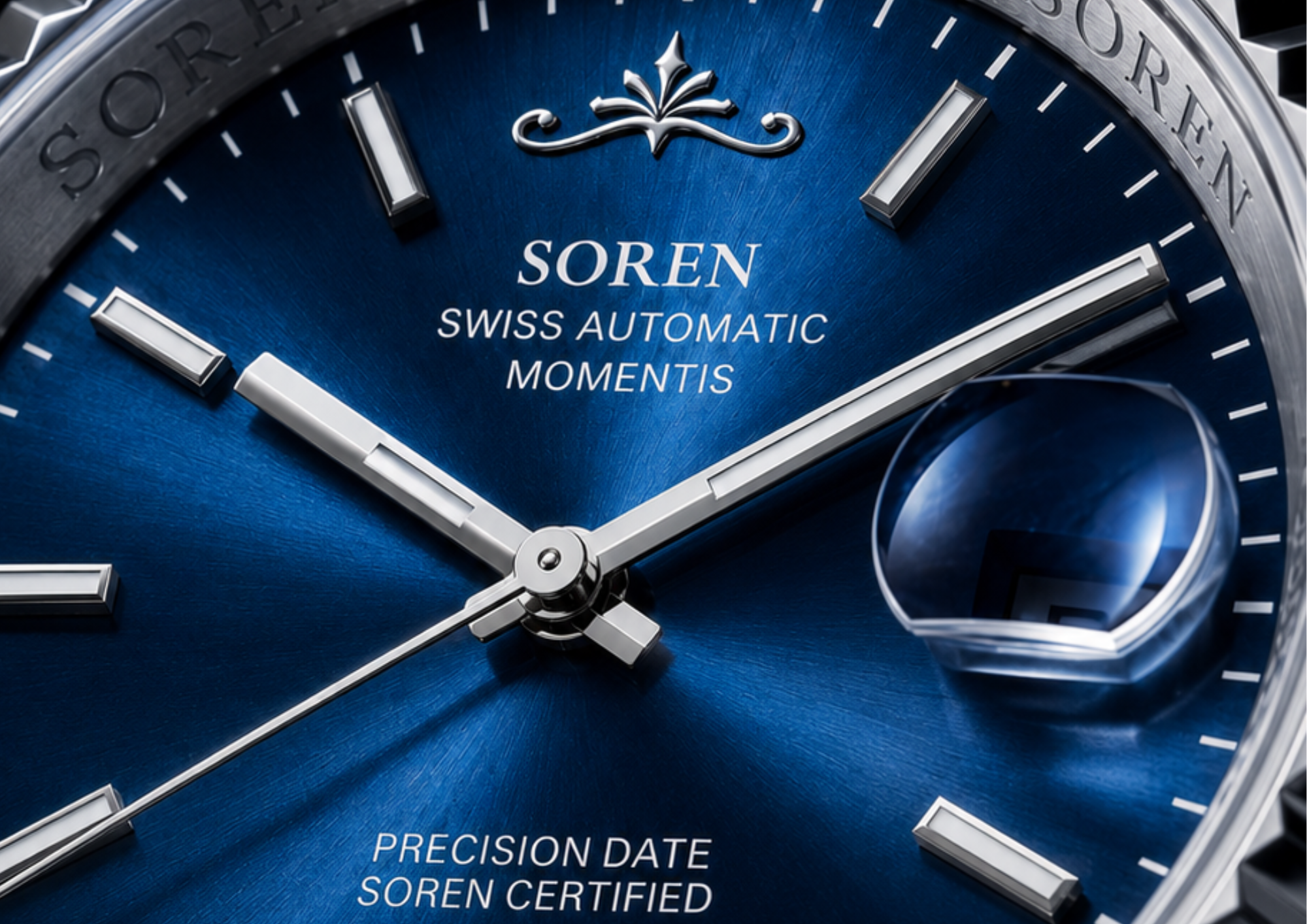
The case is 40mm in 316L stainless steel, 148 grams on the bracelet, with a 28mm lug width. Water resistance is 30 ATM, which is 300 metres. The crystal is sapphire. The bezel is unidirectional ceramic. The movement is the Sellita SW200-1: Swiss Made, automatic, 28,800 vibrations per hour, 38-hour power reserve, 26 jewels, hacking and hand-winding. It is available in five colourways with a choice of 3-link or 5-link bracelet, from €695.
Every one of those numbers is checkable, and I would encourage you to check them against anything else you are considering at this price. The comparison is the entire argument.
Why 40mm, and What That Means on the Wrist
The single most common question I get is whether 40mm will suit a particular wrist.
Dive watches drifted large through the 2010s. Forty-four and forty-five millimetre cases became normal, driven partly by fashion and partly because a bigger case is easier to make look impressive in a photograph. That trend has reversed. Forty millimetres is now where most of the market has settled, and I think it is correct.
At 40mm with a lug-to-lug that stays compact, the Oceanic sits flat on wrists from roughly 16cm to 20cm without overhang. On a smaller wrist it reads as a proper dive watch rather than a dinner plate. On a larger wrist it reads as considered rather than shrunken. The 148 grams is noticeable when you first put it on and stops being noticeable after about a day, which is the correct amount of presence for a steel sports watch.
What 40mm does not do is disappear under a tight shirt cuff. This is a dive watch. It has a rotating bezel and 300 metres of water resistance and it is built like it. If you want something that vanishes under formal wear, the Momentis is the watch in the range that does that job.
The Bezel Decision, and What It Costs
The ceramic bezel is the most expensive single decision in this watch and the one I would defend hardest.
An aluminium bezel insert would have been cheaper, easier to source, and visually almost indistinguishable in the first month. It would also have been visibly scratched within a year. Aluminium is soft. It marks against door frames, desk edges, keys in a pocket, and the tools people use when they swap straps. Once an anodised aluminium insert is scratched, there is no repair path.
Ceramic, specifically zirconium oxide, sits between 8 and 9 on the Mohs hardness scale. Practically nothing you encounter in daily life will mark it. The colour is fired into the material rather than applied to the surface, so it cannot fade from UV exposure or saltwater. I wrote about this properly in the ceramic bezel guide, including the honest downside.
Here is that downside, stated clearly. Ceramic is hard but brittle. It trades toughness for scratch resistance. If you hit the bezel hard against concrete or a rock, ceramic can chip where aluminium would dent. For office wear, travel, swimming, and recreational diving, this is a trade worth making by a wide margin. If you work on a building site with your watch on, aluminium is genuinely the better material for you, and I would rather tell you that than sell you the wrong thing.
The action is 120 clicks, unidirectional counter-clockwise. Unidirectional is a safety requirement rather than a preference: if the bezel is knocked while you are underwater, it can only ever show more elapsed time than has actually passed, never less.
The Movement: Why Sellita, Honestly
I could have used a Japanese automatic and priced the watch at €400. I could have used a cheaper Chinese movement and priced it lower still. I chose the Sellita SW200-1 and the reasoning matters.
The SW200-1 is functionally equivalent to the ETA 2824-2, which is the movement that has powered accessible Swiss watchmaking for decades. Sellita exists because ETA, owned by the Swatch Group, restricted supply to brands outside the group in the early 2000s. Sellita filled that gap and now produces hundreds of thousands of these calibres a year. It is used by a very large number of Swiss brands, including several that price their watches at three times what the Oceanic costs.
What this means for an owner is practical rather than romantic. Any competent watchmaker anywhere in the world knows this movement. Parts are available. Servicing costs roughly €80 to €150 every three to five years rather than the several hundred euros an in-house movement commands, and you do not have to send the watch back to a brand service centre and wait months.
The honest limitation is the 38-hour power reserve. Take the Oceanic off on Friday evening and it will have stopped by Sunday. Competing movements offer more: the ETA Powermatic 80 gives 80 hours, though it achieves this partly by dropping to 21,600 bph, which is why its seconds hand sweeps less smoothly. Sellita's answer arrived in February 2026 with the SW200-2 Power+, which raises the reserve to 65 hours while keeping the full 28,800 bph frequency. As Sellita transitions production, that is the direction this watch moves in.
Accuracy in normal wear sits within the movement's stated tolerance. Like any mechanical watch, it will not match a quartz movement, and if a few seconds a day genuinely bothers you, buy quartz. That is not a criticism of quartz. It is just a different thing.
Steel, and the Detail Most Brands Do Not Mention
Both the case and the bracelet are solid 316L stainless steel. No coating, no plating, all the way through.
This sounds like a small specification note and it is the single most important one on the page. A very large number of watches at this price use 316L for the case and something cheaper or coated for the bracelet, because the bracelet is where cost is easiest to hide. It photographs identically. It wears through within months at the clasp and the link edges, exposing a different-coloured base metal underneath, and there is no way back from that.
Solid 316L scratches. Everything scratches. The difference is that a solid steel bracelet can be brushed or polished back to its original finish by a watchmaker, repeatedly, for the life of the watch, because the material is the same all the way down. A coated bracelet cannot.
If you are comparing the Oceanic against anything else, ask the other brand this exact question: is the bracelet solid 316L, or is it coated? The answer, or the lack of one, tells you a lot.
3-link or 5-link
Both bracelets are offered because there is no correct answer, only a correct answer for you.
The 3-link is the three-link design. It is more robust, easier to keep clean, and visually consistent with the tool-watch character of a dive watch. It is the choice I would make for the Oceanic if I could only pick one.
The 5-link is the five-link design. More articulation means it wraps a wrist more closely, and most people find it more comfortable across a long day. It catches light differently and reads as dressier, which some people want on a dive watch and some people find slightly at odds with it.
The full comparison is in the 3-link versus 5-link guide. If you swim with the watch or spend real time in heat, a rubber strap is worth adding as a second option; the lug width is 28mm.
What I Would Change
A founder's report that lists no faults is marketing. Here is what I would genuinely revisit.
The 38-hour power reserve is the specification I am least satisfied with. It is standard for the calibre and it was the right movement choice overall, but weekend-proof would be better than not-quite-weekend-proof. The SW200-2 addresses this and I am glad it exists.
I would like more micro-adjustment in the clasp. Wrists swell in heat and shrink in cold, and finer on-the-fly adjustment is one of those details that costs little and improves daily wear more than most people expect. It is on the list.
And the watch is not for everyone. If you want a name people recognise across a dinner table, buy a brand with 150 years of advertising behind it; that is a real thing to want and I am not going to argue you out of it. If you want the most watch your money can buy, that is a different question, and it is the one I built the Oceanic to answer.
FAQ
Is the Soren Oceanic a real dive watch?
Yes, by specification. It has 30 ATM (300 metres) of water resistance, a unidirectional rotating bezel with 120 clicks, sapphire crystal, and a screw-down crown. Those are the functional requirements for recreational diving. Whether you dive with it or, like most owners, simply swim and shower with it, the rating means water is not something you have to think about.
How does 40mm wear compared to a 42 or 44mm dive watch?
Noticeably more balanced on most wrists. Forty millimetres sits within the lugs rather than beyond them for wrists from roughly 16cm upward, which is the difference between a watch that looks worn and one that looks perched. Dive watches have moved back toward this size across the industry for exactly this reason.
Can the ceramic bezel scratch?
Practically not, in normal use. Ceramic rates 8 to 9 on the Mohs hardness scale, so only harder materials such as diamond or tungsten carbide will mark it. The trade-off is that ceramic can chip under a hard direct impact where softer aluminium would dent instead. For everyday wear, travel, and water, ceramic is the better material.
How often does the Oceanic need servicing?
Every three to five years is the standard interval for the Sellita SW200-1, though many owners extend toward five to seven depending on conditions. Cost is typically €80 to €150 through an independent watchmaker, and you can use any qualified watchmaker rather than returning the watch to us. The service guide covers the warning signs to watch for.
Is the bracelet the same steel as the case?
Yes. Both are solid 316L stainless steel with no coating and no plating. This is worth verifying with any brand you compare against, because using a lesser or coated bracelet on a 316L case is one of the most common ways cost is hidden at this price point.
What is the difference between the Oceanic and the Momentis?
The Oceanic is the dive watch: 30 ATM, unidirectional ceramic bezel, from €695. The Momentis is the everyday automatic: 10 ATM, fluted steel bezel, from €625. Both are 40mm, both use the Sellita SW200-1, both are solid 316L throughout with sapphire crystal. Choose the Oceanic if you want a sports watch with real water capability, the Momentis if you want something that sits more quietly under a cuff.
Why should I trust a review written by the founder?
You should not, entirely, and I would not ask you to. Read it for the reasoning and the specifications, which are checkable, and get your opinion on how the watch actually is from owners rather than from me. What I can offer here that a reviewer cannot is why each decision was made and what it cost. The 30-day return period exists so that the final judgement is yours, on your wrist, not mine.
The Bottom Line
The Oceanic is a Swiss Made automatic dive watch with a ceramic bezel, sapphire crystal, 300 metres of water resistance, and solid 316L steel throughout, sold directly for €695. Nothing in that specification is unusual. What is unusual is finding all of it at that price, and the only reason it is possible is that there is no retailer margin, no distributor, and no sponsorship budget between the watch and you.
I am not going to tell you it is the best watch in the world. I will tell you exactly what is in it, why, and where it falls short, and let you decide whether that adds up.
Free EU shipping. 2-year warranty. 30-day returns. Swiss Made. sorenwatches.com


Leave a comment
This site is protected by hCaptcha and the hCaptcha Privacy Policy and Terms of Service apply.